Showing posts with label occupy LA. Show all posts

Unlawful Assembly at Protest: Legal Info

Unlawful Assembly at Protest:  Legal Info
(Failure to disperse)
by Sue Basko


UPDATES WEDNESDAY NOVEMBER 30/ - DEC. 2, 2011: Police raided Occupy L.A. just after midnight this morning (November 30, 2011).  Many people had been saying for days prior that the eviction was scheduled to allow Sean Penn and Ryan Gosling to shoot a movie on the City Hall site.   There has been credible evidence for days to think this is likely.  

The raid on Occupy L.A. was horrifying.  An unlawful assembly was declared and people were given 10 minutes to clear the area.   This announcement followed the script that is given below.  The announcement was made several times by an officer walking around in the crowd with a megaphone, and was repeated in several languages.   People in the camp were given ample opportunity to leave and not be arrested.  Those who stayed were opting to be arrested for their political  purposes.

However, people who were trying to leave the area after the dispersal order, and after a second dispersal order was given several blocks away later in the night, were kettled, beaten, and arrested.  People are reporting that many protesters were chased down and arrested as they attempted to leave the perimeter area.  Photos and videos are  emerging, taken after people have been released from jail today (Dec. 2) showing serious injuries to hands and arms.

All of the arrestees thus far that I have seen interviewed have complained of being driven around for hours, not being allowed to use the bathroom, that people had zip-ties on much too tight, that people were denied medical care and medicines, that people were not given water for many hours or at all, that some people were not allowed to make phone calls, that some people were not allowed to see their lawyers, that most of the prisoners were fed little (such as two meals in 3 days), that officers denied them the right to use a toilet and so people had to urinate in their clothing and then had officers mocking them, that several women were placed in isolation for no valid reason, and that dangerous medical conditions were ignored and untreated, and other things.

Monday November 28, 2011: Last night at Occupy L.A., a police officer declared an unlawful assembly at First and Main Streets and issued an order to disperse.  What this means is that there were people in the intersection, they would not get out after being asked nicely repeatedly, and so an unlawful assembly was declared so anyone in the intersection could be arrested.  Keep in mind that the police had closed off the streets, so walkers felt comfortable using the space.   

After the dispersal order, the only ones left in the street were lines of police in riot gear, and a funny man named Juan riding a bicycle back and forth wearing some kind of big headdress made of palm tree husks.  That’s L.A.!  There was also a man who had climbed high onto a light pole, with an Anonymous mask on the back of his head, shouting through a megaphone.  The crowd was comprised of many media people with cameras, some protesters, and at least one very ardent provocateur woman.   

Unlawful assembly laws differ state to state, but most of them follow the same thread.  An assembly is a group of people who gather for some purpose or activity.  If that activity is illegal, it is an unlawful assembly. If the activity is legal, but turns unlawful or looks as if it might, it can be declared an unlawful assembly. 

 
California Penal Code Section 407.  Whenever two or more persons assemble together to do an unlawful act, or do a lawful act in a violent, boisterous, or tumultuous manner, such assembly is an unlawful assembly.

Boisterous or tumultuous” means “conduct that poses a clear and present danger of
imminent violence” or when the crowd is gathered to do an unlawful act. 

For example, last night at First and Main, there probably was not any danger of imminent violence, although the mix of people in the group was definitely a tinderbox and anything could have happened.  Even if not likely to be imminently violent, the crowd was gathered for an unlawful act, namely, to stand in the street.  Note that the street was closed off by police, so there was no vehicle traffic.  The police did not declare an unlawful assembly until about 4:40 am, in anticipation that soon cars would be driving downtown with people going to work. 

First and Main is near the downtown Skid Row area, where many severely mentally ill people and drug addicts reside.  The street protest seemed to be a mix of many media reporters, out-of-towners in to show support for Occupy L.A., and a collection of Skid Row street people.  In addition to this, there were several members of the crowd who seemed to be agents provocateurs or highly irrational or unpredictable.

One scowling woman with dirty blonde hair  kept arguing with everyone and trying to provoke violence.  There were hints that she was a paid provocateur, because at one point she was arguing that the police should evict the camp since they announced they were going to.  She seemed disappointed that the raid had not gone down at the stated deadline hour.  (As of December 3, she is now seen at the GAs.)

A group was chanting about taking the street. Some whackos were making chalk drawings at the feet of the police. (I thought: They probably think of themselves as "peaceful," when in fact, they were so disrespectful.)  Meanwhile, an intense man seemed to be hallucinating and kept screaming at the police that they were the Syrian army.  He was really scary.  In short, it was time to get these people off the streets and up onto the sidewalk.  Once the order was issued, a man, who had previously been ranting and saying he was Jesus Christ, lay down on the street in a crucifixion position, but was finally coaxed up by a friendly man. 

The only actual LA Occupiers I saw in this crowd were the ones that came out to ask the people to please leave the street and go back to the park.  Sadly, the worldwide media may present Occupy L.A. as this mélange of troubled people out in the street.

DISPERSAL ORDER.  Last night, the LAPD made a loud announcement giving a declaration of an unlawful assembly and an order to disperse.  After the order was given, anyone stepping into the street, even those legitimately using the crosswalk to cross, was subject to arrest.  The police had to announce several times that this applied to the media people as well.  After the order, the only non-police person left in the street was the kooky man on the bicycle doing a parade style ride back and forth.  He provided much laughter, until a half hour later, when finally, a police officer on a motorcycle yelled at him to get up on the sidewalk.   The poor guy jumped as if he had been merrily in his own world the whole time.

Please read these rules below, which are taken directly from the Oakland Police Department Crowd Control and Crowd Management Policy, a golden bit of information that any protester should download and read.  Please read the script that the police use to declare an unlawful assembly and issue an order to disperse.  It is the same announcement as that used last night by the LAPD.   

If you are ever at a protest where such an order is issued, pay special attention to how you are supposed to exit, and allow others to exit and not be kettled up.  Last night, a lot of people were trapped and unable to move away because they had a police riot line a few inches in front of them and a densely packed group of people behind them.  The people behind, many of  whom were reporters or photographers, were pushing forward to see what was happening, which, as already explained, was a funny man riding a bicycle.   

From:  Oakland Police Department Crowd Control and Crowd Management Policy
(I strongly recommend that you download and read this Oakland policy, no matter where you are. )

F. When an Unlawful Assembly May Be Declared

1. The definition of an unlawful assembly has been set forth in Penal Code Section 407 and interpreted by court decisions. The terms, “boisterous” and “tumultuous,” as written in Penal Code Section 407, have been interpreted as “conduct that poses a clear and present danger of imminent violence” or when the demonstration or crowd event is for the purpose of committing a criminal act.

The police may not disperse a demonstration or crowd event before demonstrators have
acted illegally or before the demonstrators pose a clear and present danger of imminent violence.

2. The mere failure to obtain a permit, such as a parade permit or sound permit, is not a sufficient basis to declare an unlawful assembly. There must be criminal activity or a clear and present danger of imminent violence.

3. The fact that some of the demonstrators or organizing groups have engaged in violent or unlawful acts on prior occasions or demonstrations is not grounds for declaring an assembly unlawful.

4. Unless emergency or dangerous circumstances prevent negotiation, crowd dispersal techniques shall not be initiated until after attempts have been made through contacts with the police liaisons and demonstration or crowd event leaders to negotiate a resolution of the situation so that the unlawful activity will cease and the First Amendment activity can continue.

5. If after a crowd disperses pursuant to a declaration of unlawful assembly and subsequently participants assemble at a different geographic location where the participants are engaged in non-violent and lawful First Amendment activity, such an assembly cannot be dispersed unless it has been determined that it is an unlawful assembly and the required official declaration has been adequately given.  

 G. Declaration of Unlawful Assembly

1. When the only violation present is unlawful assembly, the crowd should be given an opportunity to disperse rather than face arrest.

Crowd dispersal techniques shall not be initiated until OPD has made repeated announcements to the crowd, asking members of the crowd to voluntarily disperse and informing them that, if they do not disperse, they will be subject to arrest.

These announcements must be made using adequate sound amplification equipment in a
manner that will ensure that they are audible over a sufficient area. Announcements must be made from different locations when the demonstration is large and noisy. The dispersal orders should be repeated after commencement of the dispersal operation so that persons not present at the original broadcast will understand that they must leave the area.

The announcements shall also specify adequate egress or escape routes. Whenever possible, a minimum of two escape/egress routes shall be identified and announced.
It is the responsibility of the on-scene OPD commanders to ensure that all such announcements are made in such a way that they are clearly audible to the crowd.
 
2. Unless an immediate risk to public safety exists or significant property damage is occurring, sufficient time will be allowed for a crowd to comply with police commands before action is taken.

3. Dispersal orders should be given in English and in other languages that are appropriate for the audience.

4. The Incident Commander should ensure that the name of the individual making the dispersal order and the date/time each order was given is recorded.

5. Dispersal orders should not be given until officers are in position to support/direct crowd movement.

6. Personnel shall use the following Departmental dispersal order:

I am (rank/name), a peace officer for the City of Oakland. I hereby declare this to be an
unlawful assembly, and in the name of the people of the State of California, command all
those assembled at _____________ to immediately leave. If you do not do so, you may be arrested or subject to other police action, including the use of force which may result in serious injury.  Section 409 of the Penal Code prohibits remaining present at an unlawful assembly. If you remain in the area just described, regardless of your purpose, you will be in violation of Section 409. The following routes of dispersal are available (routes). You have _______ minutes to leave. If you refuse to move, you will be arrested. *If you refuse to move, chemical agents will be used. (Provide the chemical warning only if use is anticipated).

7. When a command decision is made to employ crowd dispersal techniques, attempts to obtain voluntary compliance through announcements and attempts to obtain cooperation through negotiation shall both be continued. At any point at which a crowd is dispersing, whether as a reaction to police dispersal techniques, through voluntary compliance, or as a result of discussion or negotiation with crowd leaders, OPD dispersal techniques shall be suspended and the crowd shall be allowed to disperse voluntarily. This directive does not preclude a command decision by OPD to reinstate dispersal techniques if crowd compliance ceases.

*   *   *   *   *   *   *

TO SUM UP:
What happens:
1) an unlawful assembly is declared.
2) an order to disperse is announced according to above script.
3) you have to leave or face arrest;
4) you  have to leave by the route they are telling you.  It is most likely going to be hard to hear that or understand that.
5) It is possible that kettling may take place.  This is very dangerous and do whatever you can to avoid situations where the police are kettling.


Occupy Protests and the First Amendment

 Occupy Protests and the First Amendment
by Sue Basko

UDATE NOVEMBER 12, 2001:  Yesterday, Occupy Santa Rosa was granted a camping protest permit by vote of the Santa Rosa, California City Council.   They were granted a permit for 100 tents, with the permit renewable every 2 weeks.  Santa Rosa is a gorgeous place, so this is sure to be a wonderful Occupy protest.  

UPDATE (Oct. 27, 2011) - OFFICIALS in Irvine, California decided last night that they think Occupy protest tents are part of free speech.  Stay tuned on this.   ALSO last night, five San Francisco officials from the San Francisco Board of Supervisors came to Occupy SF, amidst great tension because police had been seen amassing on busses in riot gear.  The officials used the peoples' mic to give a press conference and speak to the crowd.  They showed their support and stated they were there to prevent a situation such as happened the night before in Oakland, CA.
   

The First Amendment to the U.S. Constitution says "Congress shall make no law respecting an establishment of religion, or prohibiting the free exercise thereof; or abridging the freedom of speech, or of the press; or the right of the people peaceably to assemble, and to petition the Government for a redress of grievances."  States and cities are allowed to limit the time, place and manner of free speech and assembly, as long as the limits are content neutral and are geared to public welfare and safety or for legitimate public interests. 

With the Occupy protests, the question has come up whether a City can close a park at night, or if the City must allow protests to carry on all night.  The answer is that Cities can close the parks at night, as long as this is a content neutral law.  In most cities, the law is just the law and it applies to everyone, unless they work out some kind of special deal to stay in the park later, which usually involves getting a permit and paying for security and other expenses.  For example, in Chicago downtown parks, I have seen some special events going slightly past closing time (till midnight rather than 11 pm),  but those events were carefully planned with the City far in advance and expenses were covered.

Chicago: Last night (Saturday October 22), the Chicago police arrived at Occupy Chicago in Grant Park and announced the park was closing and anyone who did not want to get arrested should move to the public sidewalk and that those who remained in the park were going to get arrested.  The public sidewalk is right next to the park and so most people just moved onto the public sidewalk.  A large group with drummers moved just across the street.  About 130 people stayed in the park, and the police arrested them.  No one resisted arrest and the whole thing was very peaceful.   

The City of Chicago was not violating anyone’s  First Amendment rights by enforcing park closure at the stated closing time. People chanted, “Whose park? Our park .”  That is not exactly accurate.  It is a park owned by the people of the City of Chicago, and run by the City for use in ways that provide the most benefit to the people of the City.  That includes scheduling what happens when and where.  Chicago’s downtown parks host many music concerts and festivals, sports, and a wide array of events of all types.  Lollapalooza, the giant rock music festival, rents out the southern end of Grant Park for several days each year.  Millennium Park, also downtown, hosts popular free concerts that bring in crowds so gigantic that the park entrances have to eventually close off to any more entry because the space is at capacity. Grant Park also hosts Blues Fest, Jazz Fest, and Taste of Chicago.  Millennium Park hosts a series of free world-class symphony concerts as well as exhibitions of giant, fascinating art.    All this takes complex planning.  Other areas of the downtown parks are set aside as quiet gardens, seating areas, fountain areas, and other areas for peaceful contemplation, reading a book, or quiet visiting with friends.   So when a group of a few thousand people shout “Whose park? Our park,” the reaction is sure, you can protest there until the park closes at 11 pm and then you need to take it elsewhere.

Please see Where You Can Protest in Chicago and How.

Getting Perspective:  It is easy when you are in a protest group to believe that your group or your cause is the most important thing in the world or that everyone does or everyone should belong to it.   

 Keep in mind that in a big city like New York, Chicago, or Los Angeles, there are different groups protesting each day.  Yours is not the only protest group – not by far.  Each weekend, there will be major protests.  Each group has its special interests.  Each group believes their viewpoint and goals are crucial.   Cities have to accommodate all the protest groups, not just yours.  Most major cities have a system worked out for how they accommodate protests.

Try dropping by protests of groups you don’t belong to, groups protesting about things far removed from your experience.  It will help give you some perspective.  You will start to understand the level of responsibility the City and the police have in enforcing basic laws in the context of protesting.  Also, if you are white and educated, it may make you think about your privilege.  You may think your group should be allowed to protest all night in a downtown park.  Would you feel the same way if a group of Blacks or Arabs decided to stand all night in the park shouting, set up tents, and claimed the park was theirs?  Or would you be relieved when the cops kicked them out?   If you are with a group you consider progressive, do you think other groups, such as neo-Nazis, the KKK, or the Westboro Baptist Church should also have the right to stay in the parks all night?  That is what is meant by content neutrality: if your group were allowed to protest all night in the park, all other protest groups could protest all night in the park.  

A protest group can influence positive change.  Many or most positive societal changes begin in such ways.  Protest is important.  Just keep in mind that time, place, and manner restrictions do not violate First Amendment rights if they are the least restrictive way to meet a legitimate State goal (such as keeping the parks nice) -- and that the restrictions apply to all groups.        

Why Do Cities Close Parks at Night?  Chicago's first park lands were purchased and planned back in the 1860s  to provide a green area respite from the noise, dirt, and congestion of the streets.  Those living in apartments and congested areas of the city use the parks as their place for fresh air, contemplation, relaxation, exercise and sports.  Parks close at night for a lot of reasons.  One is to prevent crime, such as rapes, robberies,  assaults, drug dealing, trash dumping, gang activity, and very serious things such as the dumping of murdered bodies.  Another is to prevent drifters from making it their home.  Another is to give the space a time to rest, give the grass and other plants a time to breathe without humans on them.  If there are sprinklers, they often come on at night.  Also, night-time closings are a good time for cleaning and repairs, which are often done late at night or very early morning.  Closing at night also gives a somewhat more natural environment to the birds and animals there, who do better with natural rhythms that involve some quiet and dark.  All in all, closing at night gives the parks a rest and keeps them in better, greener condition for use by all.

Who Decides What the Constitution Means and How Do they Decide?  It is said that the Constitution is the supreme law of the land.  Then people ask:  How is it that a petty park closing law can trump the Constitution?  States and cities are allowed to make laws that limit the time, place and manner of peaceable assembly or free speech, if the laws are content neutral and if they are for some important state purpose in the public welfare.  For example, I just listed above many reasons why cities often close parks at night.  Sometimes people who are arrested under one of these laws will challenge the law.  If they keep challenging it to a higher court, they may get to the point where they can challenge it before the U.S. Supreme Court.  The U.S. Supreme Court gets to decide if it will or will not hear a certain case.  When the Court rules on a case, it usually sets a precedent in law for similar situations.  Therefore, the Court chooses cases that seem important and like they will affect many people.  

The people on the U.S. Supreme Court are called Justices.  There are 9 Justices on the U.S. Supreme Court.  They are appointed by the President and approved by Congress.  Once a Justice is on the Court, they are on for life.  Once in a while, a Justice retires for health reasons.  Being a Justice is a very lofty position.  People talk about conservative or liberal people sitting on the Court.  It is very important who is appointed to the Court.  There are certainly people sitting on the Court at any given time that some people think should not be there. 

The issue of whether parks can close at night is firmly settled and clear.  This does not interfere with anyone’s freedom of speech, because they can go anywhere else and keep speaking.  It does not interfere with anyone’s right to assemble, because they can assemble on the public sidewalk all night long, they can come back during park hours and assemble there then, they can rent a meeting room and talk all night if talking all night is what they want to do, and on and on.

I heard some young men saying they wanted to challenge the park closing laws in court so they could set a precedent.  Theoretically, this is possible, although for such a case to wind its way to the U.S. Supreme Court would likely take more than 10 years and cost millions of dollars in legal fees.  Then, the Court would not likely hear the case, since the right of Cities to close parks at night is firmly established.     

Camping or Sleeping Out in City Parks or on City Streets:  Most cities do not allow camping, other than in designated camping sites, if the city has any.  This will be found in the municipal ordinance of that particular city.  Cities define “camping” in different ways.  Some codes define camping as  any use of a tent or sleeping bag in a park or on the public way.  Some codes prohibit public sleeping.  Some codes prohibit lying down on a sidewalk.  If you are trying to plan an Occupation protest, or trying to figure out your chances of being arrested, you need to know all the pertinent parts of the law.  All these factors will come into play: Park closing time, sleeping, camping, use of the public way.

Or, if you are planning to use a plaza, you need to know:  Is this plaza a "public space" or is it private?  Is the plaza part of a park?  Parks almost always have different rules than the public sidewalk or a public plaza.  Then you need to know the rules regarding sleeping and/or lying down on the sidewalk or plaza.  You also need to know the laws about camping or tents.   You will find these things scattered all throughout a typical municipal code.  Your best bet is to skim the entire municipal code and read carefully any pertinent part.

Does Not Being Allowed to Camp Out as Part of a Protest Violate Our Freedom of Speech?  The U.S. Supreme Court ruled in Clark v. Community for Creative Nonviolence (1984) that free speech expression is not violated when municipalities or parks have laws that prohibit protesters from camping in the park.  The Court found that the laws were intended to protect the park environment and were applied to all people, not just protesters, and that the protesters had other means by which to express their ideas.

Read the note above that the City Council of Irvine, California announced that they view camping with a tent as part of a First Amendment protest right.  The City has a right to decide this, as does any city.  However, the interpretation must be content neutral.  This means Irvine will not be able to deny another protest group the right to camp based on their protest message -- although they may be able to deny another group the right to camp based on other factors, such as poor planning.

Some Cities have Occupation Protests Going.  How?  The ability to hold an Occupation legally usually depends on a quirk in the law or in bargaining with the municipal officials to allow it.  

New York: For example, at Occupy New York, Zuccotti Park is open all night, camping is not allowed, but sleeping is not prohibited.  So the protesters are sleeping all night on the sidewalk, but without tents.  Many of them are getting sick.  But they are allowed to stay there by following the technicalities of the law.  (Update:  Tents are now present in the park.  Update Nov. 15 2011: Protesters were removed from the park, tents and facilities were destroyed, protesters allowed back in with no tents or sleeping bags, no no lying down allowed, and park now closes at 10 pm.)

Smaller Cities: In some smaller cities or towns, people who want to hold an Occupation protest overnight are bargaining with their local officials to permit a limited-time overnight protest, for example, for a weekend.   Some people think this is corny or defeats the purpose or idea of an occupation, which they think must be the taking or conquering of some territory.  This possibly has to do with so many Occupy participants being  recent military vets from the wars in Iraq and Afghanistan.   They are home from the war now, but they are still thinking strategically in terms of seizing territory, encamping,  and occupying.  The average protester usually wants to attend a protest for a few hours and then go home and take a shower and sleep in a bed.  The idea of making a protest into a home and a lifestyle is somewhat new, I think.  (Update: I have since hear of the Bonus Army, which  set up camp in Washington DC after World War I to protest not being paid promised bonuses.  Their protest was violently crushed by government forces.)    It is a sign of how desperate people are with the current bad state of our economy and society, and how badly they want major change.  Still, for many groups, a bargained-for short term  Occupation protest works, is peaceful, and gets people thinking about change.   It may not be an occupation in the military terms of an occupation, but as a protest, it works.

See: 25 Ways to Occupy Without Camping
See: Occupy Santa Rosa Permit Conditions for discussion of a permitted Occupy protest.

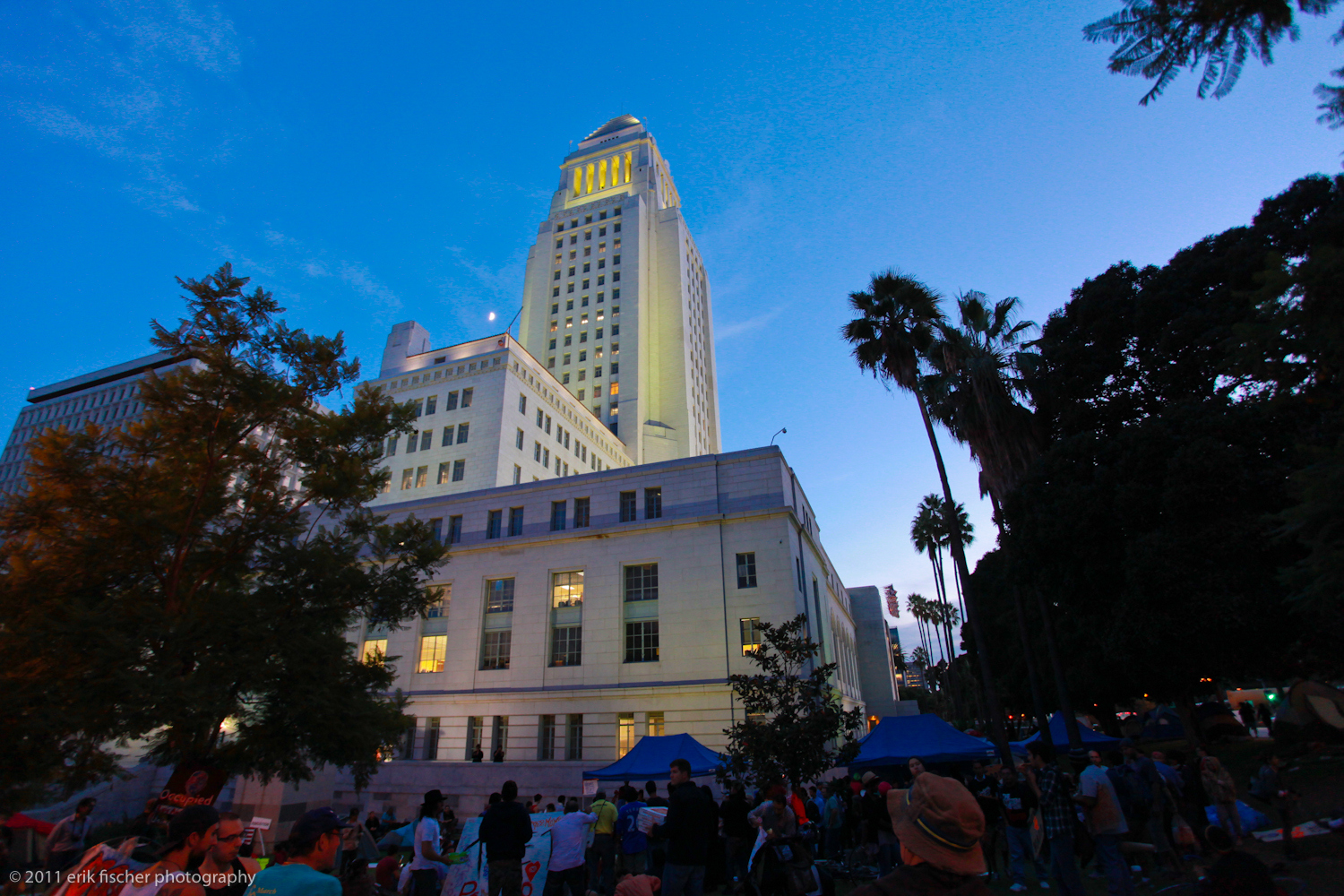
Los Angeles: Los Angeles law does not allow camping, and parks close at night.  However, there is a court case settlement that allows sleeping on the sidewalk from 10 pm to 6 am.   Occupy LA made use of this and then after several days, the City allowed the protesters to keep tents on the park space at night. However, the lawn has sprinklers that have been damaged, the grass is now dry, and this may pose a situation where the protesters will have to be asked to leave since dry grass poses a serious fire hazard in Los Angeles.  Also, although smoking is prohibited in all Los Angeles parks, some protesters at Occupy LA are smoking.  The combination of flammable tents, dry grass, and cigarettes and matches may force the Fire Marshall to end the tent city.  Update:  Occupy LA was raided on Nov 30, 2011, the park was fenced off.  The group now meets on City Hall steps for  GA several times per week, with many protests and activities taking place each week.

This is another example of how law works: A Fire Marshall is an official who must make determinations of safety and has the power to revoke permits or close events.  For example, there is a weekly Farmers Market that for years has held a permit and used the space adjacent to the filled with tents by Occupy LA.  Last week, the Fire Marshall determined that since some of the Farmers Market vendors cook and use flames, that this could not take place within 100 feet of the tents.  That is good decision-making for safety, since tents are highly flammable, people are staying in them, and the grass is very dry.  All it would take is one misplaced spark for the whole thing to ignite.  The Fire Marshall moved the market to a nearby location away from the tents.

Fire Marshalls and Safety Inspectors:  When the Fire Marshall is doing his job, he or she is empowered to make determinations for safety.   Most cities require large group gatherings to get permits.  Part of the permit process is inspection by the Fire Marshall as well as by building inspectors.  This is all content neutral – that means, these people show up to inspect  for safety, whether you are running a protest, a movie premiere, a sporting event, or a street concert.   Generally, what they inspect will include any structures, such as stages or platforms; anything overhead, such as lights, poles, domes, big tents; any large props or puppets or mechanisms; and anything made of paper of fabric, checking to see if it is fireproof and if it is hung or suspended properly.

Food Safety: Another area of inspection at an Occupation protest has to do with food service.  The same laws apply to food service at a protest as would apply at a street festival or church carnival.  It is content neutral.  They don’t care what your political agenda is – they want to be sure people are not going to get food poisoning.  That usually involves having some kind of food service sanitation permit or licensing as well as having facilities to keep food sufficiently hot or cold, which an inspector measures using a thermometer.  Food inspectors are not violating your right to peaceably assemble, they are just making sure you do not all end out assembling in an emergency room with food poisoning. 

Rights Violations:  It is possible, though rare today, that a municipality will enforce laws based on the content of a group’s message.  If that is actually happening, contact a lawyer or rights group.


To help you understand the process of running a protest, please see these other posts:

Starting an Occupation Protest:
Legal Considerations

Starting an Occupation Protest – Legal Considerations
by Sue Basko

Since Occupy Wall Street, or its corollary, Occupy NY, occupation protests have sprung up all over.  Occupy LA is the second largest “Occupy” protest in the U.S., and the most successful with the most positive impact and least amount of trouble.  It is also the one I know the most about.  This blog post explains how to go about setting up an Occupation protest.

What is an Occupation protest?  This is a protest that “occupies” a space. It might be a street or a park.  It might be a symbolic location, such as the Federal Reserve Bank at Occupy Chicago.  It might be a logical gathering place, such as City Hall Park, where Occupy LA is camping out.

Does an Occupation protest need to include sleeping out?  No, but many protest groups would like to try to do that. 

What else can an “occupation” be?   Since the purpose of an occupation protest is to call awareness to the dire financial situation and the need for change, an occupy protest can be anything that does that. Some examples are: 
  •  Having a round-the-clock protest vigil at a certain location, without actually sleeping there.
  • Having a daily or weekly protest at the same time and location.
  • Asking people in their homes to keep one light or LED candle burning in a front window each evening.
  • Having people hang a certain banner in their window in support.
  • Holding a weekly event to honor the cause – such as a bike ride, feeding the homeless, a sing-along or other such event.
  • Holding a monthly event with songs and speakers.
  • Having a website where people can weigh in and share their thoughts.

Planning a Sleeping-Over Occupation: 
Most Occupation protests that involve sleeping over are illegal.  They are illegal because most municipal codes do not allow sleeping or camping on the street or in parks.  Also, most parks have a closing time and Cities are allowed to enforce those things.  Some protests have been able to get a special permit or get the blessing of the municipality in which they are located. Some have been forced out, evicted, kicked out, or whatever term you like – often with many arrests.

Some occupation protests have been carefully planned so they are not technically in violation of the law. Occupy NY is taking place at Zuccotti Park, which a POPS (privately-owned public space), a place created for public use in a zoning deal where the builder trades greater density on the project in exchange for creating a public space. It is open 24 hours a day.  Although camping is not allowed, sleeping is not forbidden.  Therefore, protesters have been able to stay with sleeping bags, 24 hours a day.   Still, since the City has some control over the park, there have been moves to make the protesters leave, ostensibly for park cleaning.   Mayor Bloomberg has said the protesters can stay as long as they like. (Update: Tents are now present in the park. Update Nov.15 - Tents were cleared from the park again.  Also new rules say the park closes at 10 pm, lying down is not allowed, and no tents or sleeping bags are allowed in the park.  )

NOTE:  Zuccotti Park is a POPS - privately-owned public space. POPS parks and plazas come about as a zoning deal where a developer creates public space in exchange for being granted higher density in a building project.  Those spaces  have First Amendment rights because the owner has bargained with the City to create the space for the public.  However, a recent survey of POPS in New York City found that most POPS are not usable for any purpose, let alone for holding a protest.   


 When the Occupy protest first came to Zuccotti Park, the park had no closing time and there was no rule against lying down.   The protesters stayed all night and slept without tents.  Gradually, they started using tents.  Then, the camp was evicted from the Park, and the Park instituted new rules giving the Park a closing time and making it illegal to lie down.   There is a pending court case involving Zuccotti Park and the Occupy protests.  At this time, Zuccotti Park is being allowed to enforce rules similar to the rules of the New York City parks.  If this case follows logic, a POPS-created park such as Zuccotti Park would  be allowed to have reasonable rules, just as any New York City park does, such as closing time, not allowing camping, etc.  It seems logical that Zuccotti Park or any POPS park or plaza should be able to mirror the laws that apply to NYC public parks.  The court ruling will be interesting to read when it comes.  

Does Not Being Allowed to Camp Out as Part of a Protest Violate Our Freedom of Speech?  The U.S. Supreme Court ruled in Clark v. Community for Creative Nonviolence (1984) that free speech expression is not violated when municipalities or parks have laws that prohibit protesters from camping in the park.  The Court found that the laws were intended to protect the park environment and were applied to all people, not just protesters, and that the protesters had other means by which to express their ideas.  Note: in this situation, authorities allowed tents on site as a First Amendment expression, but decided that sleeping in the tents was not a First Amendment act.

Note: Since the Occupy protests began, some municipalities have said that they think camping out is a form of protest.  Irvine, California is one such place.  Some cities, such as Santa Rosa, California are giving approval for a camping protest under controlled conditions.  There, the camp is limited to 100 tents and each tent must have a permit.  To read the permit conditions, please read:  Occupy Santa Rosa Permit Conditions.

Does making us leave a park at closing time violate our right of Peaceable Assembly?  No, municipalities and States are allowed to place time, place and manner restrictions on the right to peaceably assemble, as long as the restrictions are content neutral and narrowly tailored to meet important government objectives.  Content neutral means the laws apply to everyone regardless of their message.  Cities can close the parks at night, and most cities do.  Some cities require permits for large park gatherings or for any use of a sound system.  Chicago, for example, requires a park permit for any park gathering of over 50 people and for any use of a sound system in the parks.

If you want to protest all night long and not have it end in possible arrest, you have to do one of these:  1) protest on the public sidewalk all night long (but not sleep there, unless you are in Los Angeles);  2) find a place that does not close, such as Zuccotti Park where Occupy NYC is happening (that is no longer an option in Zuccotti Park, as the rules have changed in Zuccotti Park) ;  or 3) cut a deal with local officials to let you stay in a park all night long, as has happened at Occupy LA, Occupy Santa Rosa, and other locations.   A good number of municipalities have agreed and backed the protesters, so do not think it is impossible.    If you are protesting on the street at night, the same laws apply as always apply on the street at night, such as curfew times for children and teens out without their parents, noise ordinances that usually prohibit any loud noise at night, parking laws,  and any other laws that normally apply.

What About Los Angeles?  Los Angeles does have a “tent city” going in City Hall Park.  Los Angeles is a special case.  The protesters at Occupy LA planned to “occupy” City Hall Park, a formal area of lawns, trees, and parquet brick walkways surrounding downtown Los Angeles City Hall.  No camping is allowed in Los Angeles, other than in designated camping locations, such as camps in mountain parks.  City Parks close at times ranging from 9 – 11 pm, and reopen in the early morning.  City Hall Park closes at 10:30 pm and reopens at 5:00 am. 

An interesting glitch in Los Angeles law allows people to sleep on the sidewalks from 9 pm to 6 am.  This is not contained in the municipal law, but is the result of a court case settlement between the ACLU and the City. The settlement was meant to stop the arrests of the homeless who were sleeping on the sidewalk because they had nowhere else to go.  The settlement applied to the whole City and to any person, and did not require any particular motive for sleeping on the sidewalk. This is not contained in the Los Angeles Municipal Code, rather, it is a separate court settlement that inactivates police enforcement of a section of the code.

 The “skid row” area of downtown L.A. has for years now turned into a tent city at night – and in the early morning, the tents’ occupants wake up, pick up their tents, and move away.  Many sleepers can also be seen on Hollywood sidewalks, usually with sleeping bags or bedrolls, rather than tents.  Many people sleep under freeway overpasses.  If you call the L.A. police at night to say a person is sleeping on the sidewalk, they tell you it is legal.

 In some areas of L.A., apartment building managers place old couches on the grass by the curb, waiting for trash pick-up that rarely happens.  These couches are soon claimed by sleepers.  In some neighborhoods, a nighttime walk can feel like tip-toeing through an eerie outdoor dormitory. 

I once saw a large conference table being discarded near the curb by a church in Hollywood.  The space under the table was quickly claimed as “home” by several people.  They had a roof over their heads, Hollywood style.  It’s not all Entourage fantasy in Los Angeles, though the people living under the table did have a view of the famous Hollywood sign up on the hill. 

Suffice it to say, Los Angeles has a strong tradition of sleeping on the sidewalk.  Occupy LA decided to occupy the park by day and move the tents to the sidewalks at night.  After several days of this, the City Council powers-that-be allowed them to keep their tents in the park at night.  So now, it is a tent camp on the lawn of City Hall Park. They have had to move from one side of the lawn to the other several times to accommodate a film shoot or other event.  Some nights, they have been asked to move the tents to the sidewalk so the lawn can be watered by the automatic sprinklers.

Occupy LA includes a food tent, a media tent that hosts live streaming video as well as creates short videos of Occupy LA events, a library tent, a medical tent, and a welcome tent that greets visitors and receives donations.  Occupy LA has its own volunteer security force, hosts many classes, runs a nightly General Assembly meeting, has hosted speakers and musicians, has a noon-time speaker series, and invites people out to local protests at banks or other locations.

Occupy LA has limitations.  Among the things not allowed in the park are cooking, fires, dogs, smoking, alcohol or drug use, and amplified sound.  These limitations apply always to all using the park, not just protesters.  Also, the food tent must get a permit from the Health Department, which is in process.  Porta-potties had to be furnished.  

Occupy LA has been officially endorsed by the Los Angeles City Council.  Most participants and supporters are delighted about this, while a few others complain about it.

How Can We Know if it is Legal to Sleep Over in a Certain Location?  Check the municipal code of the city or town of the park or location.  You can probably find the Municipal code online by googling on the name of the City, State, and “municipal code.”  In the municipal code, to find the applicable sections, search these terms: Streets, Camping, Public Way, Parks, Tent, parkway.  Also, go to the Table of Contents of the Municipal Code and read the header for each section.  You may find multiple areas that apply. 


What if it is Illegal to Camp Over at Our Desired Location?  You can try asking the municipality to grant you permission, if it is land owned by the municipality.  Or you can look at different locations and see if any others have different laws that apply.  Or you can stage your occupation and risk being kicked out or arrested.  In some locations, police evicting protesters have damaged or destroyed items such as tents, sleeping bags, cooking facilities.  Or you can “occupy” in a different way that does not involve sleeping overnight. See the list above on different ways to "occupy" or invent your own way.  


Some Other Main Legal Considerations in a Sleep-Over Occupation Protest: 

Eating/ Cooking / Serving Food: One of the main legal and practical considerations is how people will be fed.  Is it legal to cook on-site?  It is legal to start a kitchen?  Does the food area meet health department requirements?  Several recent "Occupy" protests have had their kitchens or cooking facilities closed or dismantled by local authorities.  These are complicated issues.  In any case, your protest is more likely to last if you deal with these matters cooperatively when they come up.   Health authorities patrol street fairs and street vendors and they know what  is likely to make people sick.    The main issues seem to be having a sanitary food service area, whether licensing is needed, serving homemade food is often not allowed, temperature levels (hot and cold), whether hand washing or sanitizing is available and enforced, and whether cooking is allowed in the location.

Toilets:  Are they available?  If not, or if there are not enough, can you get porta-potties?  Do you need a permit to place them?  How many are needed for the expected number of people?  How often do they need to be serviced by the company?   Who will clean them each day?  This can be a big expense; how will it be paid?   Can you get and place wheelchair-accessible porta-potties?  For an event lasting a full 24 hours (round-the-clock), 4 porta potties per 100 people is recommended, if they are cleaned regularly.  Each porta-potty lasts for about 90-100 uses before it must be emptied.  Prices on porta potties differ greatly, depending on the amenities and style.  Over a 2 week or longer period for a large group, a simple rule of thumb is that rental of basic porta-potties and supplies needed will cost about $1.50 per person per day.  At an occupation protest, the porta-potties are likely to be the biggest expense, greater even than food, since much of that will be donated.   In almost all places, urinating or defecating outdoors is illegal.  And you cannot count on nearby businesses welcoming a steady flow of protesters in to use their bathrooms.   The success of your protest hinges on getting porta-potties.

Noise/ Sound:  Check the municipal laws and park laws and rules regarding noise, sound, and amplification.  In most places, the general rule is that  you need a permit to use an amplifier or megaphone outside.  Another general rule is that even with a permit, sound cannot project too far.  Generally that means that from a distance of 100 feet away, the noise cannot sound louder than a normal conversational tone. Another general rule is that constant or repetitive noise, such as drumbeats or banging noises, is only allowed for short periods of time in certain locations and not at night.   Another general rule is that noise is not allowed at night, which in most places is 9 pm, but may be an hour later or earlier.  Another general rule is that if the police or other authorities or nearby neighbors tell you to lower the noise, you have to do that or you will likely be cited and/or arrested if you are noncooperative.   Some municipal laws or park laws spell out the details of all this, others leave it more vague and commonsense.  Locate the laws that apply to your site and read them carefully.  These may include a municipal code, a county code, a parks code, park regulations within a municipal code, state law, park rules or park postings, signs, etc.

Trash/ Recycling:  You need to plan and budget for trash pick-up and recycling.  There will be many plastic water and drink bottles.  Disposable plates and cups, plastic flatware, and food wrappers can leave an enormous amount of trash.   The area you use must be kept free of any trash, including any cigarette butts.  All of this takes advance planning, supplies and services,  budgeting, and cooperative people willing to help.  Leaving any kind of mess will get you citations or arrests and make you most unwelcome.   This applies to any kind of outdoor event, not just a protest.

 How to Plan and Occupation Protest

Occupy L.A. Eviction

Occupy L.A. Eviction
by Sue Basko

see also: Occupy Los Angeles Eviction photos

UPDATE WEDNESDAY NOVEMBER 30, 2011: Police raided Occupy L.A. just after midnight this morning.  Many people had been saying for days prior that the eviction was scheduled to allow Sean Penn and Ryan Gosling to shoot a movie on the City Hall site.   There has been credible evidence for days to think this is likely.

The raid was horrifying, but the police were mainly non-violent.   People were given ample opportunity to leave and not be arrested.  People are reporting that many protesters were chased down and arrested as they attempted to leave the perimeter area.  There are also reports that some such people were beaten.  

* * * * * * * * *  

“Hey you kids, get offa my lawn,” said the Mayor, “or I’m gonna call the cops.”   Actually, Los Angeles Mayor Villaraigosa and Police Chief Beck have said they will send social workers and trucks to help people move from the Occupy LA encampment in City Hall Park.  Some protesters are resigned to moving, while others plan to stay until forcibly removed.

Legality:   Protesters could legally sleep on the sidewalk from 10 pm to 6 am, and then protest on the sidewalk all day.  It is questionable whether they could keep tents up all day on the sidewalk.  There is a court case about this for the Skid Row District, but I am not sure it applies to the whole City.  Moving to the sidewalk would be less comfortable, but then, getting wound up with zip-ties and bussed off to jail is not comfortable, either.

If the Occupiers stay, the likely possible legal repercussions are:  being cited or arrested for illegal camping, a City Municipal Code violation;  being cited or arrested for trespass;  being ordered to disperse as an unlawful assembly, with either City or State violations for that. If the City issues its own citations, the City then retains more control over the outcome, and thus, more bargaining power with the group and increased future rapport.  If the the Occupiers are arrested on State criminal violations, that shows the City is throwing its hat out of the ring and loses all bargaining power.

 Quite simply, many of the Occupiers are homeless and have nowhere suitable to go.  Forcing them out only highlights this fact and should be a moment of shame for the City.

Whatever happens to Occupy LA in these coming days, there have been Lessons that could be learned from Occupy LA.  The whole Occupy movement has made me think and this is what I’ve come up with:

1) Community Living.  People like living in community, especially single people.  Many people do not mind Spartan living conditions if it means they can share in the energy and life of others.  Sharing meals and sharing chores feels good when with people who share values and goals. Community living buildings were once popular, when the U.S. cities proliferated with residences for young men, working women, and people in the arts.  I think community living buildings are the wave of the future.  It is cheaper to share a kitchen and a bath and main rooms and more fulfilling to live in relation to others.

2) Mental Health.  The lack of adequate mental health care and facilities in the U.S. has come home to roost.  The mentally ill need places they can stay all day, all their lives,  and get the treatment they need, without being put through any hoops to get it.  Los Angeles has tens of thousands of mentally ill people roaming around, hanging out in libraries, sleeping on sidewalks, pushing shopping carts full of bottles.

3) Military vs. Living.   The U.S. need to shift expenditures from military to education, housing, nutrition, and healthcare.  We have become a nation supporting and engaging in  non-stop killing and violence in other nations, rather than a nation providing the human basics needed at home.  Wealthy companies that get military contracts are the only ones benefiting.  And of course, there is the immorality of raping, pillaging, maiming, and killing our fellow human beings.

4) Small Businesses.   The U.S. needs to entirely get out of forcing red tape, paperwork, and hassles onto small businesses.  "Jobs" is an antiquated and fantasy notion, where an outside force provides you with pay and work that you hope will match with your skills and interest.  People today need to develop and market their own skills.  The government makes this almost impossible for people to legally do.

5) Health Care.  We NEED to have national healthcare that has nothing whatsoever to do with “insurance.”  Insurance is a form of gambling that says some people will not seek health care, thus paying for others.  What we need is clinics and doctors where everyone can go and get basic health care. 

6) Workers and Jobs.   The U.S. needs to start protecting jobs for U.S. workers.  HB-1 Visas should end.  Allowing businesses to send jobs overseas should end.  Allowing a whole system of underpaid and unpaid labor should end – from workers in the country illegally, to restaurant wait staff being legally paid far less than minimum wage, to students and graduates “interning” for no money, all the way to Arianna Huffington selling the Huffington Post for $315 million and refusing to pay the writers.  Where is the decency or fairness in any of this?

7) Government.    The whole U.S. system has gotten too complicated.  Everything is a giant hassle of laws and rules and paperwork.  No one knows what is going on.  Privacy has been invaded from all angles.  Most people no longer have the basics of what they need, so the system is not really working.  If a government is costing billions and billions of dollars per day and yet is providing almost nothing of value to the average user, it is time for an overhaul. 

   
  See also: