Ukraine Protest Support

Ukraine Protest Support 
please watch and share


Human Rights Watch asks OSCE to send a Human Rights envoy to Ukraine immediately:


OSCE Guide to Peaceful Assembly:

Basic Venue Safety
for festivals, Concerts, Shows, Protests, Parties


Basic Venue Safety
for Festivals, Concerts, Shows, Protests, Parties, and More
by Susan Basko

See also: Counter-Protesters and Counter-Demonstrators

When you gather a large group of people for an event, your top most priority should be their safety.  Disasters happen very quickly and are almost always avoidable.  The conditions that cause a disaster are almost always the result of those running the event taking a shortcut, not thinking things through, being lazy, or being cheap.   By "disaster," we mean something that causes multiple deaths or injuries. In a venue disaster, the deaths will usually be from smoke/fire, trampling, or crushing.

The place where the event is being held is the venue.  The venue may be indoors or outdoors. Disasters happen at outdoor venues, too.  Different types of events have different purposes, but the safety factors on all of them are quite similar.   Here are some basics:

Capacity:  Every venue, indoors or out,  has a maximum legal capacity of how many people are to be allowed in.  Exceeding the capacity is extremely dangerous.  The capacity of an indoor venue may be stated as one number if standing and another number if seated.  If a venue is such that patrons are flowing in and out, then you must use counters and see how many are inside before letting more in.

At most venues, the legal capacity is posted on a sign on the wall.  If you make a habit of looking at these signs, you will see that most venues have a much lower legal capacity than you might expect.  The legal capacity is based on square feet, purpose, whether patrons will be standing or seated, and if seated, at chairs or at tables, number of exits, number of toilets, and other factors.  It is great for an event to draw a crowd, but if the crowd exceeds the capacity of the venue, it is dangerous.

Permits/ Inspections:  Almost every locale requires any venue to be inspected and licensed as a permanent venue or permitted as a special venue.  These permits and inspections go a  long way in providing for safety. Most locales will inspect the layout of the space, the exits, the smoke detectors and sprinklers, lighting, electricity, platforms and stages, structures, props and hangings, sanitation, and any food service.  Many locales have written laws, rules, or policies that spell these factors out in detail.  You should work with people who know the rules and follow them.  Buy the guidebooks and have your staff use them.

Layout:  The floor layout for an event should be done in advance to scale with a computer rendering.  It should be done according to the local laws.  By law,  there must be large amounts of space between two tables.  By law, there must be a very wide open space in front of and around any exit or pre-exit.  A pre-exit is the exit from a room to another space that is not the outdoors.  A venue may have 5 or  6 pre-exits from the event space to the outdoors.  Each pre-exit must be carefully planned and the space around it must be laid out properly.   At set-up time, the floor is measured and marked with chalk, so the layout matches the rendering.

Exits:  Disasters often happen because there are inadequate exits or exits have been blocked or locked. Even if a place has been inspected and licensed, if a manager or security guard gets it into their heads to lock exits, for their reasons of "safety," they can invalidate the license, invalidate the insurance, and endanger lives.  Never allow anyone to lock or block an exit.  If a venue has been licensed or permitted based on  a certain number of exits, if one of those exits is not functioning, at any time or for any reason, the entire venue becomes unsafe and usually also is invalidating its license and insurance and well as endangering lives.  If a venue needs to hire an extra set of people to stand by a door to make sure people do not sneak in, or whatever the concern is, then that is what must be done.  An exit cannot be locked or blocked for any reason.

Never allow any item to be placed in front of an exit. Items that some may be tempted to place in front of an exit include a ticket table, merchandise table or booth, autographs table, coat rack, etc.   Laws in most places require wide aisles or spaces between tables or between banks of chairs, and at least 10 feet of clearance in all directions at any exit.  Most places require lit "Exit" signs.  Venues should have emergency light systems that go on if the other lights fail, or in case of smoke or fire.

Exit Path:  The exit path should be designed so that each succeeding exit space is bigger and wider than the last.  This is equally important at an outdoor venue as indoors.  There was a terrible crushing disaster a few years ago at an outdoor festival where the exit gates led to a wide space that then led to a narrower tunnel.  Too many people got into the tunnel and people were crushed to death.  In an indoor venue, make sure the exit bath is not made narrower by lines to bathrooms, furniture, a snack bar, magazine racks, etc.  If the lights are out and the place is dark and filled with smoke, anyone walking or crawling to an exit should meet no obstacles.  Turn out the lights and try it.

Fire Hazards:  Disasters have been caused by such things as sound insulation that was not fireproof, use of pyrotechnics, decorations that were not flameproof, patrons using lighters to see, and other such things that, in hindsight, were easy to detect.  Absolutely any item that is used as a structure, decoration, prop, or furnishing in a venue should be flameproof or highly flame retardant.  Hold a lighter to it for 10 minutes and see if it burns.  Curtains, insulation, table cloths, upholstered chairs, decorations, etc. must all be flameproof.  Pyrotechnics or flame should never be used indoors and if outdoors, should only be run by licensed professionals in a space that has been inspected by a fire marshal.   Venues that bend these rules are the ones where a disaster is more likely.

Structures:  Collapse of stages or structures is sure to be disastrous.  Hire only a licensed, bonded, insured company and have the structures inspected by an outside source.  If a stage or structure appears to be top heavy, flimsy, off-balance, shaky, etc., it probably is.  Such situations may occur because those holding the event are trying to cut corners, save money, do things cheaply.  This is unacceptable.

Crushing: Crushing disasters happen when too many people get into one space at one time.  That's simple and logical, but preventing it is a fine art.  At outdoor venues with open lawn area, venues still often have the area just in front of the stage as a seating area, often with tickets. This is to prevent stage crush.

Even if an entire venue has seating, there can be crush if open seating, first-come, first in is used.  This is sometimes called "festival seating," a term that makes no sense, since the audience at a festival does not sit, but walks around.   This type of ticketing has been outlawed in some places.  It is much safer to assign tickets to seats.

Rowdy Patrons:  Patrons who are intoxicated or agitated can present a danger, obviously.  The usual techniques of screening at the entry and a good security force work well to prevent fights.  However, rowdy people are also the ones likely to cause a panic that leads to a rush to the exits.  A rush to an exit can happen quickly.  Security should be trained to isolate and contain any incident, so it does not result in a rush of people, with danger of a crush.  Making sure the venue is laid out properly and that it is not over capacity also helps avoid crush or rush.

Human Rights Defenders Risks


 Human Rights Defenders Risks
by Susan Basko

I was recently asked to assist in an international Consultation of Human Rights Defenders. In the consultation, we were making recommendations for the protection of people who are seen as Human Rights Defenders. I was asked to participate in the consultation because I actively defend the Human Rights of association, assembly, protest, speech, press, media, and technological use of media (such as live streaming, wifi, etc). The consultation was conducted by ODIHR (Office of Democratic Institutions and Human Rights) of OSCE (Organization for Security and Cooperation in Europe). There are 57 OSCE participating nations, and the U.S. is one of them. The Recommendations will be published in 2014. I have been invited to assist OSCE ODIHR with several major activities over the past couple years, based on my assistance to protest planners and media activists in the US. and worldwide. I distributed the consultation form to many others in the U.S.
.
Once the Recommendations have been compiled, they will reflect trends of risks that are faced by those who defend Human Rights. The OSCE has 57 participating States from Europe, Central Asia and North America: Albania, Andorra, Armenia, Austria, Azerbaijan, Belarus, Belgium, Bosnia and Herzegovina, Bulgaria, Canada, Croatia, Cyprus, Czech Republic, Denmark, Estonia, Finland, France, Georgia, Germany, Greece, Holy See, Hungary, Iceland, Ireland, Italy, Kazakhstan, Kyrgyzstan, Latvia, Liechtenstein, Lithuania, Luxembourg, Malta, Moldova, Monaco, Mongolia, Montenegro, Netherlands, Norway, Poland, Portugal, Romania, Russian Federation, San Marino, Serbia, Slovakia, Slovenia, Spain, Sweden, Switzerland, Tajikistan, fYR Macedonia, Turkey, Turkmenistan, Ukraine, United Kingdom, United States, and Uzbekistan.

BELOW I AM POSTING MY REPLIES TO THE QUESTIONS. The compiled Recommendations from the 57 nations will be available some time in 2014. I could have spent my entire reply on the shocking hate launched at me by disturbed sociopaths on twitter, but decided those sort of attacks by people with that type of social/ mental disorder are likely to be covered by others.

I feel greatly honored to be invited to assist in improving society within the 57 nations. My experiences with OSCE over the past two years have been meaningful and important. There is a great connectedness and commonality nation to nation between those of us protecting Human Rights. There is an energy of truth and goodness that can be felt when these people gather.

Question 1: Risks, threats and challenges
Which are the specific risks, threats and challenges you (or your organization) face as a result of your human rights work? 

Please provide a brief summary of the specific risks, threats and challenges (e.g. physical and verbal attacks and threats, legal persecution and harassment, restrictive NGO legislation, restrictions to freedom of expression, assembly and association etc.) you or your organization experiences and you consider should ideally be addressed in the OSCE/ODIHR Recommendation. If available, please also provide concrete examples of incidents or documented cases of abuses you/your organization faced. Please do not exceed the given word limit. For further details about specific incidents or cases you may want to include references to published documents or materials if available.

In your response, please also include if you or others belong to a group of human rights defenders that is at particular risk and whether you see specific gender-related challenges in relation to your work and the risks and obstacles you face.

Summary: Description of main risks, threats and challenges you/your organization face/s [MAXIMUM 700 WORDS] 
(e.g. physical and verbal attacks and threats; lack of effective remedies and impunity; legal persecution and harassment, criminalization, defamation campaigns; restrictive NGO legislation, obstacles in receipt of funding, burdensome administrative requirements and informal pressure; restrictions to freedom of expression, assembly and association; surveillance and undue interferences in private life; restrictions on freedom of movement and access to carry out human rights monitoring and reporting; lack of opportunity for participation in public affairs; impediments to access and communicate with international bodies and reprisals; etc.): 

Answering on behalf of self as lawyer and many organizations and individuals to whom I give assistance:

1) Activists are having Child pornography emailed to them in tricky ways, to set them up for legal troubles and prosecution. It is unknown who is doing this, probably individuals outside the government. Govt needs to be aware of this practice and beware of prosecuting. There is one known prosecution at this time of media activist in North Carolina.

2) The U.S. government is sending National Security Letters to activists and freezing assets. The NSLs state that the person or organization or someone else is under investigation, cooperation is demanded, and not even the letter can be revealed. I am not allowed to give details, but I am aware of several of these that have had the effect of stopping participation.

3) The U.S. government and its contractors are using Twitter personas to stalk, harass, belittle and demean others. This is obvious to regular twitter users and has a chilling effect.

4) U.S. government is prosecuting journalist Barrett Brown for posting a link online to materials that were hacked. Raises dangerous practice of prosecuting people for posting links and puts HUGE damper on press freedom and communication freedom. This is a giant issue and entire US and world should be in opposition to this prosecution. Brown was writing about US govt using private companies for surveillance and linked to online info about the companies. Indictment has about 12 counts for one link with potential of decades in prison.

Specific examples of incidents and documented abuses (please add references to published materials as may be required) [MAXIMUM 400 WORDS]: 

1) Activists being emailed child pornography to set them up for prosecution:
Happened to Luke Rudkowski, Dan Johnson, Stewart Rhodes, and about 12 other people that I am aware of as a lawyer. There is one known federal prosecution based on possession of a Child porn image, of a man who is a media activist. Case is federal and in Middle District of North Carolina, but I am not at liberty to write the man’s name yet, but it is a fed case on pacer.gov

Info and Video about Dan Johnson et al:
http://subliminalridge.blogspot.com/2013/07/child-porn-emailed-to-activists-to-try.html

Info on Luke Rudkowski:
http://subliminalridge.blogspot.com/2013/07/attempt-to-set-up-journalist-with.html

2) National Security Letters: By law, cannot give details. But I am aware:
http://subliminalridge.blogspot.com/2013/11/national-security-letters-help.html

3) Persona Mgmt: http://occupypeace.blogspot.com/2011/12/fake-profiles-used-for-spying.html

4) Barrett Brown prosecuted for posting a link:
http://subliminalridge.blogspot.com/2012/12/barrett-brown-charged-with-posting-link.htm
l

Question 2: Recommendations
Based on the protection gaps and needs identified above: What measures should OSCE participating States take in order to strengthen the protection of human rights defenders and guarantee an enabling environment conducive of their work, both domestically as well as across the region?

If relevant specify by which state actors (e.g. government, regional and local authorities, public officials) the measure(s) should be taken. Also include: (a) what specific mechanisms and procedures participating States should put in place domestically to guarantee the protection of human rights defenders (recommendations concerning domestic processes/mechanisms for implementation); and (b) what participating States should do to support the protection of human rights defenders and promote an enabling environment in third countries (recommendations concerning protection of human rights defenders abroad). 

Measures participating States should take in order to strengthen the protection of human rights defenders and guarantee an enabling environment conducive to their work, including recommendations concerning (a) domestic processes/mechanisms for implementation; and (b) protection of human rights defenders abroad. 
[MAXIMUM 1000 WORDS]

1) Governments and people and organizations should be made aware of this new practice of tricking people into downloading Child pornography images onto their computers in order to set them up for later legal troubles. Some of the images are being sent embedded in pdf files. Governments should set up a specific and obvious protocol for anyone to whom this has happened. Awareness, education, training.

2) The U.S. practice of sending National Security Letters in what appears to be a misuse of their purpose should be addressed. The NSLs are supposed to be used for important anti-terrorism purposes and are now being used to thwart protesters, media, etc. Awareness, education, training, legal challenges.

3) Practice of using social media for COINTELPRO and harassment of activists should be forbidden.

4) Governments should be barred from prosecuting the use of links/ hyperlinks by anyone online, including activists, journalists, independent media, researchers, or ANYONE. Links should not be treated as a wrongdoing or crime in any way.

David Coombs speaks re Pvt Manning - CA and WA


Public presentations by attorney David Coombs

coombsDavid Coombs, attorney for American prisoner of conscience US Army Pvt. Chelsea (formerly Bradley) Manning, will speak at three upcoming West Coast events hosted by the Private Manning Support Network. Mr. Coombs continues to represent the heroic WikiLeaks whistle-blower recently sentenced to 35-years in military prison.

Sunday, Dec. 8 at 7:00pm -- Los Angeles CA
The Church in Ocean Park, 235 Hill Street, Santa Monica CA 90405 - View flyer (pdf)

Monday, Dec. 9 at 6:30pm -- Oakland CA
Humanist Hall, 390 27th Street, Oakland CA 94612 - View flyer (pdf)

Wednesday, Dec. 11 at 7:00pm -- Seattle WA
University Temple United Methodist Church (Fireplace Room), 1415 NE 43rd St., Seattle WA 98105 - View flyer (pdf)

Events will include Q&A with Mr. Coombs, and a fund pitch by the Support Network to benefit Pvt. Manning's ongoing defense efforts, including pending legal appeals.
Events are presented by the Private Manning Support Network and Courage to Resist, with the help of Veterans for Peace, CODEPINK, Bay Area Military Law Panel, War Resisters League-West, Project Censored and the Media Freedom Foundation, SF Women in Black, World Can't Wait-SF Bay, OccupySF Action Council & Environmental Justice Working Group, OccupyForum, SF LGBT Pride Celebration Committee, Queer Strike, National Lawyers Guild-SF, and the Civilian-Soldier Alliance, MLK Coalition of Greater Los Angeles, Interfaith Communities United for Justice and Peace, Progressive Democrats of Santa Monica Mountains, March Forward, The ANSWER Coalition, Common Good Café, G.I. Voice / Coffee Strong, Peace Action Group of Plymouth Church UCC, Fellowship of Reconciliation-Seattle Chapter

$5-$10 donation requested at the door to cover event expenses. Wheelchair accessible. For more info, contact: Courage to Resist, 510-488-3559.

Help us continue to cover 100%
of Pvt. Manning's legal fees! Donate today.

National Security Letters: Help!


National Security Letters: Help!
by Susan Basko, esq.

Someone delivers a document of many pages to your home or office.  It does not look like anything you've ever seen before.  It says you or someone else is under investigation by some Department of the U.S. government and that you must cooperate.  It also says that you are ordered not to tell anyone about the letter or its contents.  You are alarmed and afraid, likely terrified.  Congratulations, the government has just treated you to a National Security Letter.  Here's a few things to know:

1) You can always show the letter to a lawyer.  The letter says you cannot disclose it to anyone, but that does not include that you cannot show it to a lawyer.   In fact, you should show it to a lawyer so they can help you understand what it is and what it means. The lawyer is also under the gag or nondisclosure order and cannot reveal the letter to the press or public.  It is good to have someone else know about the letter, and legally, you cannot tell anyone, not even  your spouse, that you received the letter, or anything about its contents.  So, show it to a lawyer.   

2) National Security Letters include a gag order, also known as a nondisclosure order.  The recipient is  supposed to tell no one about the letter or about what is being investigated.  They are not even supposed to tell that they got a Letter.  The National Security Letter may go into rather extreme detail, for many pages, listing off what it means by "don't tell anyone."   

3) A National Security Letter may be issued to a person or to a company.  The most likely sort of companies are those that deal in internet communications or finances.  Larger companies are more likely to have a lawyer on staff and to be familiar with the Letters.  Individuals or small companies that receive a National Security Letter are more likely to be baffled and frightened by the letters.  

4) A Judge in the Federal 9th Circuit (California, Washington, Idaho, Montana, Alaska, Nevada, Arizona) has ruled the gag orders unconstitutional, but has given the government time to gets its act together.  We'll see what happens.  As of now, recipients of a National Security Letter must comply with the gag order. 

Update September 2019:  The Constitutionality of the gag orders contained in National Security Letters has been the subject of back-and-forth litigation, as described in this handy Wikipedia article: https://en.wikipedia.org/wiki/National_security_letter    If you want to know whether a particular gag order is Constitutional at a given time, you would do best to do solid legal research to know the status at that time.

5) National Security Letters can be used by many federal government agencies.  In some instances, the main purpose in using a letter seems to be the gag order, rather than the investigatory portion. In other words, the letters appear to be used to shut people up.   Sometimes, this may be a valid purpose.  It helps, in assessing a letter, to judge whether the purpose appears to be more investigatory or more to keep the person from going to the media or to the public about a particular topic.

6)  A National Security Letter is supposedly issued for purposes of investigating terrorism or topics of concern to national security.  "National security" has become a broadly-used term that can mean almost anything involving the public or the government.  The governmental agencies are now issuing a huge number of National Security Letters.  That's a lot of intrusion into peoples' lives with no judicial oversight. 

7) If a National Security Letter requires its recipient to hand over information, that information is supposed to be non-content.  For example, if the letter is demanding email information, it is only supposed to be asking for who was contacted and when, not the contents of the emails.  Content-based materials are supposed to require a subpoena or warrant.

8) To send a National Security Letter, the government agency does not need probable cause or to go before a Judge, as is the case with a subpoena or warrant. This makes National Security Letters much more of a fishing expedition and opens them wide for abusive use.  The letters are seen as stepping stones to creating probable cause.   

9) National Security Letters contain a gag order that may be the main purpose of the letter.  If you worked for a government agency and were investigating something sensitive, and if you had an easy tool where you could order everyone involved to keep quiet, would you use it?   Likely so.

10) Tens of thousands of National Security Letters have been issued each year since they were instituted. The Letters are considered by many to be abuses of Constitutional rights.

11) A National Security Letter has 4 main parts.  First, it will tell which agency is investigating.  Many U.S. agencies have been given authority to send National Security Letters. Second, the Letter will tell who or what is being investigated. It may be the recipient, in which case the main purpose is likely to gag the person from speaking privately, publicly, or to the media about the topic or about the letter.  Or the letter may state that someone else is under investigation and may demand that the recipient hand over the requested information about that person, company, or organization.   Third, the letter will state what materials, if any, must be handed over.  Fourth, there will be a detailed gag or nondisclosure order.  If this is highly detailed, then the recipient may assume the main purpose of the letter is to force the recipient to keep quiet because an investigation is ongoing.  

12) A National Security Letter has the force of law.  For example, if the recipient talks to people or to the media about the letter, the recipient can be charged with a crime.  Likewise, if the recipient fails to comply with the demand for information, the recipient might be jailed.  This is very important to know.   

13 ) If you plan to violate the demands of the Letter, discuss first with a lawyer.  Several business owners have closed down their services rather than compromise the future privacy of their clients.   One such business owner is Ladar Levinson of Lavabit, an encrypted email service.  It is believed that Lavabit received either a National Security Letter or a secret subpoena.  Rather than comply, Mr. Levinson closed the service.  He was immediately threatened with jail, but it is dubious the government could force him to keep running his business so they could use it to spy on people.   You can read Mr. Levinson's letter about this HERE, or below:

My Fellow Users,
I have been forced to make a difficult decision: to become complicit in crimes against the American people or walk away from nearly ten years of hard work by shutting down Lavabit. After significant soul searching, I have decided to suspend operations. I wish that I could legally share with you the events that led to my decision. I cannot. I feel you deserve to know what’s going on--the first amendment is supposed to guarantee me the freedom to speak out in situations like this. Unfortunately, Congress has passed laws that say otherwise. As things currently stand, I cannot share my experiences over the last six weeks, even though I have twice made the appropriate requests.
What’s going to happen now? We’ve already started preparing the paperwork needed to continue to fight for the Constitution in the Fourth Circuit Court of Appeals. A favorable decision would allow me resurrect Lavabit as an American company.
This experience has taught me one very important lesson: without congressional action or a strong judicial precedent, I would _strongly_ recommend against anyone trusting their private data to a company with physical ties to the United States.
Sincerely,
Ladar Levison
Owner and Operator, Lavabit LLC
Defending the constitution is expensive! Help us by donating to the Lavabit Legal Defense Fund here.

How to Plan a Million Mask March

How to Plan a Million Mask March 
in 10 Easy Steps
by Susan Basko

Maybe you've heard about the Million Mask March scheduled for November 5th.  This is a world-wide peaceful march. Maybe you want to plan a march for your own city or town.  Here is how.

Here is some credible information about MMM:
The official website with local events: http://millionmaskmarch.wordpress.com/
The official FB event invite: https://www.facebook.com/events/505027169551591/
The official MMM Twitter acct: www.twitter.com/MillionMaskMarc 

 NOTE:  Do not get involved in groups other than those listed at the links above.  There are some strange groups forming from questionable sources.  

HOW TO PLAN A MILLION MASK MARCH in 10 Easy Steps:

I) First check to see if there is a march already planned for your location. If so, join in with that group. The list is here:  http://millionmaskmarch.wordpress.com/

II) If you need to plan your own march, it is too late in almost any city to get a permit. Therefore, to run a legal protest, you will need to hold it in a plaza or on the public sidewalk.  How to do this:

1) Choose a location that is a publicly-owned plaza such as by a City Hall, government building, etc. or a place on a public sidewalk.   If possible, get a local lawyer to help you with your plans.

2) The date is November 5, 2013.  Choose a 2-hour time slot.  Most likely is a 2-hour slot between the hours of noon and 8 pm.   That is a Tuesday.  For example, 2pm - 4pm is a great time slot.  But if you want students and workers to be able to attend, then 5-7pm or 6-8pm might be better.  Plan according to what works for your people.  The time slot is start to finish and includes gathering, running your protest, speakers, music and dancing, ending, and clean-up.  Plan and write your schedule and get helpers to keep it on time.

3) Create a facebook page for your event. Invite people using the Facebook invite system. Invite others.

4) Make a twitter account for your event.  Post your updates.

5) Put your march on the list: http://millionmaskmarch.wordpress.com/

6) Send out press releases: http://millionmaskmarchmap.wix.com/info#!pressrelease/c1tsl

7) Check your state and municipal statutes to see if it is illegal to wear masks in public.  If it is, print up masks, back them with cardboard or foam core board, and tape them to a flat stick, so you are holding them, not wearing them.  MASK TO PRINT: http://www.guyfawkesmask.org/ 

8) Plan what you are going to do at the protest.  Dancing, music, a speaker, drums, etc. are all good.  It is nice to have a live streamer, live tweeters, photographers, videos, etc.

9) The theme is freedom of internet and freedom from surveillance.

10) Run your protest.  Afterwards, clean up.  Pick up any papers or fliers that were dropped on the ground.  Leave the space cleaner and neater than you found it.

Raided by the FBI: What to Do


Raided by the FBI: What to Do
by Sue Basko, esq. 

This is a guide for activists who have been or might soon be raided by the FBI.  This applies to online and IRL (in real life) activists.  After a recent raid of a client, I spoke with a lawyer for the FBI.  She was perturbed that I used the word "raid," rather than her preferred term, "execution of a lawful search warrant."  The legality of such searches is always in question.  And, when a person's home is stormed by FBI agents with guns, it is popularly referred to as a raid.

This guide does not apply to you if the FBI is raiding you mainly for stashes of guns, bomb-making supplies, chemical agents or other weapons, illegal porn or obscenity, drugs, or because you have bodies hidden in your crawl space.  Okay?  You're not an activist.

This guide also does not apply if the FBI raid is on a business.  For helpful hints on how to prepare and deal with a business raid, see this GUIDE by the law firm of Kirkland and Ellis.  Some of the ideas in that guide, such as videoing the search,  sound difficult to pull off.  However, the guide is likely to be helpful overall and it is well worth reading now and implementing the advance preparations.

WHY THE FBI RAIDS ACTIVISTS:  The FBI ostensibly raids the homes of activists because they believe that by searching the homes, they will find evidence of a crime. In fact, it appears that the FBI conducts raids on the homes of activists to rein them in, warn them, threaten them with what could happen, to cause them trouble in their lives.  Raiding the home of an activist has a chilling effect against that activist, their group,  and may scare off other participants from exercising their First Amendment rights.

The legally stated purpose is that an FBI agent believes evidence of a crime will be found in the house.   That crime does not have to be one committed by you for your home to become subject to a search warrant.  The alleged crime may be one committed or planned by others in your group. That's why it's real important to watch out who you let into your activist circles and to exclude those advocating violence, etc.

Today's buzzwords that help back up "probable cause" to raid an activist include: anarchist, black bloc, Anonymous, hacker.  Back in the 1950s, it was Communists. In the 1960s and early 1970s, it was anti-war, SDS, Yippie.  In the later 1970s and 1980s, the focus was on cults and communes. In the 1990s, the fear was of protesters against animal and ecological abuse.  The 2000s brought fear of alleged terrorists.  Now, it's Black Bloc with their bandannas and Anonymous with their Guy Fawkes masks.

Be careful not to portray yourself or allow others to portray you in ways that do not reflect reality.  For example, an online news site wrote of one of my clients, "Another Anonymous Hacker Raided by FBI." I pointed out that he was not a "hacker." Then, they called him an "Anonymous Leader."  Again, I pointed out -- he was not a leader, and Anonymous has no leaders.  Another irresponsible website called one of my clients "a mind control occultist."  He had nothing to do with mind control or the occult.  And on and on.  If the website or writer is not malicious, they will make the correction and remove the offending material.

SIGNS YOU'LL BE RAIDED:

1) Harassment. Before the home of an activist is raided, the FBI will almost always make contact with that person.  This is in the FBI protocol handbook.   This may happen in the form of a contractor.  Usually, there will be someone in person or online who is harassing, following, being too nosy.  Or there may be several people.  If you are an online activist or have an online presence, there are likely to be so-called "trolls" or abusers bothering you.  Some activists, before and after being raided, have been  harassed, impersonated, lied about, etc., by strangers or acquaintances online.  Many of these harassers may be sock puppet personas.  The activist may "know" the persona, but not know in actuality who is behind it.  The correlation between being abused online and being raided is very strong, and it can be most helpful to take action to block the abusers.

2) Visit from an agent.  An FBI agent or two may come to your door to talk to you.  This may happen months before you are raided.  If they show up at your door, you are on their radar.  Anything you tell them can and will be used against you.  It is illegal to lie to an FBI agent, so you are much better off declining to speak than rattling off a mistruth.  "I don't know," is a lie if you do know.  If there is a situation where your telling what you know is likely to save lives or keep people safe, then there is good reason for you to share what you know.  Otherwise, the usual legal advice is to say you cannot talk, but ask for a business card.  Then you can speak with a lawyer and decide what to do.

3)  Someone casing your place.  Before the FBI gets a warrant for a raid, they send an agent to the building to get very exact directions and descriptions on how your place can be found.  They take photos of the building exterior, and hallways and doorways. If you are in an apartment, they may get a floor layout from the management.  These items end out attached as part of the search warrant.  Several people who have been raided  noticed this reconnaissance mission about 1 - 2 weeks before they were raided.  There was someone who did not belong. The person will go all the way to door and past it, to see what is beyond.  Several  people who have been raided have told me they saw such a person at their home or apartment building, and thought it odd.  It can be a warning sign that the warrant is being prepared and a raid is imminent.

4) On the day of the raid: WHEN:  Most federal search warrants are required to be executed between 6 a.m. and 10 p.m.  Most raids take place bright and early.  A search warrant can be executed while no one is home, and the door will be broken into.  On homes, that is rare, though I have heard of it happening on offices of activist groups.  If the FBI claims that you present a special risk, they can ask the Judge to allow the raid to take place at any time.  That's when they do a raid at night using night vision goggles, etc.  This is more likely if there is strong reason to think there are weapons likely to be used by those inside.

Local police are also more likely to conduct a raid at night, use flashbangs, hold those inside handcuffed and at gunpoint, etc.  Local police units conducting such raids tend to be sloppy, illegal, and highly dangerous.  The FBI will usually follow the FBI rules, which require the raid to be conducted between 6 a.m. and 10 p.m., and using force only if needed.

Several people have told me that the first sign they knew they were being raided was they heard unusual sounds.  These may be the sounds of many vehicles arriving, agents surrounding the residence, a walky-talky radio, voices heard outside windows that are in private locations, the sound of things being moved outside, such as patio furniture being moved, nearby dogs barking, etc.

Where force is used, the people may hear flashbangs, which are percussive fireworks, loud bangs that sound like very loud gunshots or a small explosion.  I guess the flashbangs are supposed to wake up the occupants and let them know they are being raided.  After flashbangs are used, the raiders then shout out "FBI!" or "Police!"  This generally scares the shit out of the people inside, and sets the tone for a very aggressive, unpleasant experience for all.  It is illegal for the FBI to use force unless a Judge has given permission in a warrant or if circumstances truly require it, which they rarely do.

5) On the day of the raid: HOW: Often, an agent will go to the front door of a residence.  When the person answers, the agent will announce he or she has a warrant.  They are supposed to show the warrant and give a copy.  Then the raid team will enter the residence.

6) On the day of the raid: WHO: In most raids that I know of lately, there have been 12 or more agents entering the home, and guns have been drawn.  The people participating in the raid may be a combination of FBI, NSA, local police, US Marshals, Secret Service, DHS, etc., depending on the location and situation.

7) THE WARRANT: Affidavit.  To get a search warrant, an FBI agent must write up an affidavit, which is a document that has numbered statements of alleged fact on it, and it is signed.  The affidavit must tell WHAT crime the agent believes has been committed and WHY he thinks there is evidence to be found at your house, and WHAT evidence he thinks is at your house.   The FBI agent then brings the affidavit to a magistrate judge, who decides whether or not to issue a search warrant.  I am told that if a magistrate judge wishes to keep his job, he approves all search warrant applications brought to him by the FBI.

In theory, the person named in the search warrant may be able to get a copy of the affidavit. This can be useful as evidence to challenge whether there was probable cause to conduct the search. In reality, most federal cases against activists are kept sealed and the documents are not revealed.  Many such searches do not turn into indictments and are never unsealed.  Thus, it usually remains a mystery what probable cause, if any, was used to get a search warrant on the home of an activist.

A search warrant is usually against a specific location.  That might be a house, an apartment, an office,  a storage locker, etc. I have also seen search warrants against a specific computer server or against a server cabinet.  The search warrant will specify if it is looking for items belonging to or under control of a certain named person.

WHY IT IS SO IMPORTANT TO AVOID "TROLLS" ONLINE: Many of the "trolls" online are actually people working as contractors/ informants.  It is very likely their (mis)information is used as a basis for probable cause to get a search warrant. "Trolls" are known to lie, fabricate entire events, circumstances, and connections, impersonate, fabricate responses, set people up to respond or participate in their own self-defense, create false documents, send false emails, and on and on.

This is why it is so important for activists to shun "trolls" or those with "trollish" behavior.  It should be assumed that any person engaging in such behavior has a paycheck coming for it.  If not, then they would stop such behavior upon having it pointed out to them that it is socially unacceptable.

From what I have seen in recent case after case is that online "trolls" harass and stalk the activist target before and after a raid.  In the case of Barrett Brown, "trolls" were even present in the chat room while he was raided and arrested.  The correlation between an activist being harassed by "trolls" and being raided seems very high, and it seems the higher the intensity of troll activity aimed at a person, the higher the likelihood they are to be raided.

8) THE WARRANT: What's in it.  The search warrant lists what places may be searched and what may be taken.  You should ask upfront for a copy of the warrant and read it before allowing the agents into your home.  Of course, it is hard to have the presence of mind to do such a thing when you are confronted by people with guns.  If you can do so, calmly take your time and read the warrant.  This could easily take 20 minutes or more, as there are likely to be 4 - 8 pages.  It is a good idea to read it.

NEVER GIVE PERMISSION for any area to be searched if it is not listed on the warrant and never give permission for anything to be taken if it is not listed. NEVER sign anything agreeing to any such actions.  For example, a warrant may be for items under the control of the person named in the warrant. If the residence is shared, permission should never be granted to search the rooms or seize items not under control of the person named in the warrant.  This is especially crucial in roommate or shared housing situations or in family situations where there are older or adult children.  ALSO, as to planning, if you are in a shared housing situation, it is a good idea to have a house rule that no one is allowed to keep their personal items in shared common spaces.

It can also be extremely dangerous to share a computer with anyone.  And if you have wifi, have each person have their own password.  Never leave wifi unprotected without a password.  It is a good idea to password protect a computer if you are leaving it alone. I had a client years ago, a university student,  whose landlord was entering the apartment while the student was at school. The landlord would use the student's computer to download obscene materials.  Try to be sure no one else has access to your computer(s), because you can be blamed for everything that takes place on your computer.

10) WHAT IS LIKELY TO BE TAKEN IN A RAID: When searching the home of an activist, the items that are most likely to be taken are:
  • Computers of any kind or size, hard drives, disks, data sticks, and any other data storage device. 
  • Cell phones.
  • Notebooks and papers.
  • Photographs. 
  • Masks, banners, pamphlets, fliers, bandannas.   
 Other Items:  If any other items are in the residence and are illegal but were not listed on the warrant, a second warrant may be issued.  For example, if there are illegal weapons of any kind or illegal drugs, even a pot plant,  the agents may hang around for a long time while one goes and gets a second warrant to take those items.

11) SEARCH: What they do: Many agents with guns will enter your home.  They may handcuff you or the other occupants.  They may force you to stay in a certain location.  They may say you are free to go, but most likely, you want to be there to have some idea of what they are doing to your stuff.  There will be one or more agents who will work on your computer, possibly downloading things or checking things.  They will later pack up your computers and take them.  The other agents will tear your house apart, moving furniture and dismantling things.  They will load things into bags and carry them out.  They will leave your home in an absolute, ransacked mess.  They will give you a receipt for the items they took.   You may lose your data, your records, precious photos, etc.  They will take your computers, phones, papers, etc.  

12) TRUST.  It bears mentioning that once your home is searched, you will never again trust the government or law enforcement.  If you are an activist, the same applies to your relatives, neighbors, friends, your circle of activists, and others who hear of the situation.  I estimate that for every FBI raid on the home of an activist, trust is decreased in probably over a million people,  in varying amounts, and for a time period probably extending 50 years.  The ripple effect seems to be very wide and very long-lasting.  These kind of raids harm the fabric of society and erode any confidence in the integrity of law enforcement.  It is very easy to view law enforcement officers as thugs when they show up at the homes of citizens and take the computers they use for their work, the phones they use to talk with family and friends, years of personal photos, and personal journals.  At this time, such raids have become widespread.  We are in a dire time in U.S. history.  Please pay attention.


13) SEARCH WARRANT VS ARREST WARRANT: A search warrant gives the FBI the right to search the place and seize the items listed in the warrant.  An arrest warrant gives them the right to seize and take a person.   Once an activist has had a search warrant against their home, they are usually afraid that an arrest warrant will follow.  By the apparent numbers, this rarely happens.  Most of the searches appear to be "fishing expeditions" or based on false or trumped up "probable cause."  (Hence, see the notes herein warning about "trolls.")

After a raid, it may be in your best interest to get off social media, or if you stay on, at least remove contact by trolls or problematic people.  It may also be in your best interest to let your lawyer handle certain contacts, such as with media, people with questions or concerns that seem nosy or inappropriate, etc.


WHAT TO DO and DON'T DO DURING A RAID:  
  1. DON'T answer questions and don't offer information. 
  2. DON'T interfere.  
  3. DO Make it known if you have medical conditions that need to be tended to. 
  4. DO get a copy of the warrant and read it before you let them in. 
  5. DO get a copy of the receipt. 
  6. DO try to call a lawyer.  
  7. DO take videos or photos of the agents, etc.  You are legally allowed to film law enforcement officers while they are working, so if you can, then do so.  It is likely to cause a ruckus, so be aware if you are going to try it. 
The Right to Remain Silent only works for those who keep their mouth shut.  If you start blabbing, trying to explain, offering information, trying to assure the officers that you have done nothing, answering questions, etc., you are giving up your right to remain silent and everything you say can and will be used against you.  Can and will be.

WHAT TO DO AFTER A RAID:  
  1. Get a lawyer.  This is crucial.  You don't necessarily need a criminal defense lawyer since you have not been charged with anything. But you need a lawyer to protect you and look out for your good.  Ask around for lawyers from different organizations.  Put the word out that you need a lawyer.  Most often, there will be a lawyer willing to help you.  Once you get a lawyer, let them handle things for you, such as any contact with the FBI.  Also, let your lawyer screen or front media contacts for you.  Let them decide if they want you to talk with any given media person and on what terms.  
  2. Try to get your stuff back.  Have a lawyer work on this.  There is a motion that can be filed to try to get your things returned.   The requirements of this motion are nearly impossible to meet, so much so that it is unlikely anyone has ever gotten their items returned by using the federal motion.  In addition, since most activist cases remain sealed, there is no way to really file a motion since the paperwork cannot be viewed.  Also, if the items can be replaced by purchasing new ones, it is assumed in law that you can simply go buy new ones -- even if you have no money.  Also, after a certain amount of time when charges are not filed, sometimes the FBI will just return your items.  Have a lawyer ask for you.  Don't do this yourself. 
  3. Get medical help.  If your home has been raided, you likely have medical injuries as a result.  This can come from being held in one place for too long, not having medications, from the stress and shock, from handcuffs, etc. 
  4. Get psychological help.  You have been in a terrifying situation and it is best to have professional help to deal with it. You will likely experience nightmares, panic, fear, etc.   You may face loss of a job, an apartment, and even loss of some friends.
  5. Decide if you want to go public.  This is something you should carefully consider.  Most activist cases are kept sealed during the warrant phase.  If you don't publicize it yourself, it may not become public news.  People have been fired from jobs or lost their apartments because of being raided by the FBI or police.  In most situations, this is legal.  On the other hand, the only way to gather support is by letting others know what happened and what kinds of help you need.   A downside is that going public tends to draw more "trolls" who are likely to criticize, lie, spread misinformation, harass your friends and supporters, stalk your lawyer, and try to thwart your efforts to gather funds or support. 
  6. Avoid Online "Trolls" or in-person Stalker types.  These people may be merely annoying busybodies, but they may also be contractors or informants or agents trying to gather information or trying to trick you into saying something or doing something that will give cause for you to be arrested, and will impede your efforts to get legal help, funding, or support.  You may be best to get off social media for a while, or to limit your contacts and remove those who are trolls.
ADDITIONAL SEARCHING THAT MAY HAPPEN:   When your place has been raided by the FBI, you are under investigation, and it is not likely to stop with the search of your home.  In addition, the FBI may also have a secret warrant to place a video surveillance camera in your place, and may be doing that during the raid, if it is taking them a long time.  They may also get warrants or subpoenas against your email, social media, and other online accounts.  They may also do a "mail cover," which is when they ask the postmaster for data of all the mail that has gone to and from your address.  The outside of all mail is photographed and when a mail cover is requested for a certain span of dates, that information is turned over to the FBI.  They may also subpoena your ISP (internet service provider)  or phone records.  If they wish to listen in on your phone calls, they may place a fake "stingray" cell tower that attracts your phone signal,  so they can listen in.   If you drive a car, they might get a subpoena to put a gps tracker on your car.  

As one of my clients says, in the face of all usurpations of your constitutional rights, "Just keep swimming."  Just keep engaging in legal, constitutionally-protected First Amendment activities.  


Psy-Ops/ Troll Tactics


Psy-Ops / Troll Tactics
bag of tricks
by Sue Basko

The psy-ops/ trolls/ contractors whose job it is to mess with activists have reached into an advanced bag of tricks.  Their online tricks go far past the usual discrediting, name-calling and stalking.

The internet has given psy-ops a whole new set of opportunities - they can work from anywhere, they can have dozens or even hundreds of identities at once, they can use persona management software to run their different identities, one identity can have multiple operators, other identities can be used as a swarm of others who "agree" with the offensive psy-op identity.   Also, online services such as Twitter have shown themselves to be so lax in protecting users that it can be assumed they are, if not in league with government contractors that harass, at least acquiescing to their destructive tactics.

PLEASE NOTE THAT ALL THE PSY-OPS TACTICS LISTED ARE CRIMINALLY ILLEGAL, as well as being immoral and unethical.   Also, if these acts are done by government or contractor psy-ops, there is absolutely nothing in law that allows these sort of tactics to be used against the people.  But, as many have noted, our government is now doing many things that are illegal and unconstitutional.  Sad, but true.

Sadly, these same kind of malicious online tactics have led to a steady stream of suicides, mostly of high school or college students who have been cyberstalked.  It is such a shame that stalking/ trolling/ psy-ops is not dealt with quicker and more harshly.   I think this sort of online stalking is allowed because the government and its contractors want it to be easy for themselves to use.  The government bought the persona management software; they intend to keep using it.

Two activist journalists that complained of being harassed are including Barrett Brown and Michael Hastings.  Julian Assange's mother is constantly harassed by troll accounts.  From the left to the right, activists and activist journalists are being harassed or psy-oped.

Whenever I see any of the activities listed below, I assume the person is being paid to act maliciously, or that they are direly mentally disturbed and socially rotten.  There is no other suitable explanation.

Here's some of the stuff I've noticed lately:

FAKE EMAILS: The psy-op creates an email account with your name  and emails people as if you.  

FAKE EMAILS 2: The psy-op creates an email account with the name of someone you know, trust, and deal with regularly, and emails you strange things, trying to confuse you.


FAKE DOCUMENTS, FAKE-HACKED: The psy-op creates fake documents or emails, posts these onto Pastebin or some such place, claiming these are real documents or emails that were hacked by them or that were passed to them. Then the psy-ops tweets out links to the fake document, claiming it is by you.  Remember, he who smelt it, dealt it.  If someone is posting links to such things, that person very most likely also created the thing they are posting.

FAKE HACKING:  The psy-op says their twitter account has been hacked, and then starts posting tweets supposedly by the hacker.   They use a secondary account where they claim to be struggling to get their account back.  While the account is "hacked," they post things that are supposedly written by the hacker, raid their own contacts list, etc.

POSTING PRIVATE CORRESPONDENCE: The psy-op posts emails or messages that were sent privately to them.  Why do they do
this?  To prove they are not trustworthy.  Who wants to be viewed as untrustworthy?  Weirdos and creeps.  Not sure how they think this gives them any points, or with whom.  Perhaps they are getting points from other trolls or psy-ops?  If you see a person posting private correspondence publicly, this is a sure way to know the person is either a paid psy-op or an untrustworthy, unprofessional person best to avoid. 

FAKE PHOTOS:  The psy-op posts photos and claims it is someone it is not.  Why? Just to cause confusion and mistrust, it seems.  

EMAILS WITH ILLEGAL CONTENT:  Some psy-op has been sending emails containing child porn to activists, in an attempt to entrap them.  READ MORE HERE.  This is desperately malicious.   Another variant is malware that pops up on a person's computer claiming the person has viewed child pornography and must agree to pay a fee to avoid prosecution. This is totally fake and illegal. 

RETWEETING TWEETS of others excessively, or from accounts that have you blocked.  This is an old type of harassment technique.  It's a form of stalking.  It is like the old child trick of repeating everything the other person says.  A person doing such things is either mentally ill or a paid psy-op.   

STALKING ON FACEBOOK and copying the person's posts and posting them elsewhere.  This is a form of stalking/ harassment.


FAKE PEOPLE:  Vicious trolls create fake personas who develop relationships with their target victims.  This has been an elaborate trick engaged in by psychopaths, made much easier by the internet.   There have been news stories of young victims who were "in love" with a fake boyfriend or girlfriend who suddenly dumps them.  Sadly, these fake identities have usually been created by adults trying to harm the young person.  Do psy-ops operatives also engage in long term relationships with their victims by pretending to be an interested friend or lover?  Possibly.  There have been hints at several such stories online.

STALKING OTHER PEOPLES' WEPAY ACCOUNTS:  If  a person or activity asks for donations, you either donate or you don't.  It is a sign of a psy-op or troll to post complaints against the person.   Many such complaints come from people who continuously stalk others. If there is a situation where you have actually purchased something that you have not received, that is one thing.  However, if you are making it your business to mind other peoples' financial business, you are most likely a stalker, troll, or psy-op.

Recording a Cover Song: Most Basic Things in Music Law #1


Recording a Cover Song: Most Basic Things in Music Law #1
by Sue Basko

Want to record a protest or revolutionary song by Bob Dylan, Michelle Shocked, John Lennon, or any other songwriter?  Here's how.

It's easy to legally record a cover song.  A cover song is a song written by someone else.  Just go to Limelight www.songclearance.com and pay a $15 service fee and about 10 cents in songwriter royalties for each copy of the song that you wish to make.  Limelight takes care of all the work for you. So, if you want to make 100 copies of a song you, will be paying  the $15 fee plus about $10, or $25 total.

You can also use a service by Harry Fox.  Or you can do it yourself, but that is complicated.

These kind of licenses are called mechanical licenses.  The royalties are called mechanical royalties.  Mechanical royalties are used to make CDs, internet downloads, vinyl (wax), etc.

The mechanical royalty fee is the same per copy for any song, whether it be by an incredibly famous artist or by a local songwriter.  The royalty rate has been set by law, or statute, and so is called a statutory royalty.  The royalty rate at this time is about 10 cents per song copy. 

The songwriter or publisher is compelled by law to allow you to record the song once you give notice of your intent to take a license on it.  That is why a mechanical license is called a compulsory license.  It is compulsory for the songwriter/ publisher to give you the license.  Limelight and Harry Fox take care of the process of giving notice to the right people and paying the royalties.

In most other nations, the songwriter royalties are paid after a song copy is sold.  In the U.S., the royalties are paid upfront in advance, before the song copies are sold or distributed.

You owe song royalties for every copy you make, whether you give those away for free, sell them, or let them sit in a box collecting dust.

These rules apply if: 
1) You are recording and producing the recording in the U.S.; 
AND
2) You are selling the recording in the U.S.;
AND
3) The song is subject to the U.S. Copyright laws.

 And .. that is all there is to it.  So, go record your favorite hit song.  Have fun.

Barrett Brown at Writers Retreat


Barrett Brown at Writers Retreat
by Sue Basko

Barrett Brown, the Texas journalist, has been enjoying a long stay at a federally-sponsored Writers Retreat in Dallas.  The retreat includes accommodations and meals, access to a library, and plenty of time for reading and writing.  During his stay, Barrett has written several essays that received prominent placement in good publications.

Mr. Brown was nominated for his stay at the Writers Retreat by FBI Agent Robert Smith and U.S. Assistant States Attorney Candina Heath.  Agent Smith became interested in Brown's writing in early 2012.  Although Smith is an FBI Agent, and not a literary agent at all, he recognized provocative writing when he saw it.  He soon became the biggest fan of Brown's journalistic research and writing on surveillance companies.  In March of 2012, Agent Smith planned a surprise visit to Barrett Brown's residence to seek out samples of his writing, in fact, to confiscate his entire laptop computer full of writing.  Barrett Brown was not quite ready to share his writing with Agent Smith, and so allegedly hid his computer in a dish cabinet at his mother's house.  Agent Smith, not one to take "No" for an answer, especially when he is interested in a writer's latest work, rushed over to Barrett's mom's house and dug out the computer.

Mr. Brown's entry into the Dallas Writers Retreat was delayed until September of 2012, nearly six months after the nomination by Agent Smith.  By September, Barrett Brown had grown frustrated and angry that this FBI Agent wannabe Literary Agent had run off with his computer and writing.  Brown made a series of 3 Youtube videos directed at Agent Smith. The videos went viral and were widely hailed as being breathtakingly hilarious and deadly serious at the same time.  Soon, Agent Smith and his friends were knocking down Brown's door to let him know he had been accepted into the exclusive, invitation-only Dallas Writers Retreat.

Agent Smith and U.S. Attorney Candina Heath, as Barrett Brown's retreat sponsors, are ever on the lookout for his welfare.  To that end, they recently filed a court motion to try to keep media types from saying bad things about Barrett.  Smith and Heath, a dynamic duo, filed a brief stating that nasty people  online had written that Brown was incarcerated. Oh my, we all know he is at the Writers Retreat!  Others had called Brown, among other things, an anarchist, atheist, junkie, name fag, and moral fag.  According to Smith and Heath, the media types also said Brown hung out with members of Anonymous, made prank phone calls, and didn't have a steady job.  That list describes about 50% of young adults today, but Smith and Heath care so much about Brown that they sought a court order to protect him.   Since they could not gag the media types, they asked the Judge to gag Brown himself, which basically means Brown cannot defend himself or counter what is written about him.  But never mind, be assured this is being done for Brown's happiness and welfare.

In addition, Agent Smith had listened to recordings of all of Barrett Brown's phone calls made while he has been staying at the Dallas Writers Retreat.  Agent Smith testified about each phone call, and told, in a nutshell, how each person that Barrett Brown had called had tried to manipulate Brown during the phone conversations.  Brown, apparently, does not know how to pick his friends, how to conduct phone calls, or how to see to his own good, and thank heavens he has the ever-caring Agent Smith to watch out for him.

The Court Order does allow Barrett Brown to continue to write and publish on topics other than himself.  Brown looks forward to a continued productive stay at the Dallas Writers Retreat.  Agent Smith and AUSA Candina Heath are proud and pleased to have Barrett Brown on the roster at the retreat, and hope to be able to offer him a long and delightful stay so he can build up his repertoire of writing, as well as learn how to make better friends.

Anonymizer: What is it?

Anonymizer: What is it?
by Sue Basko

 UPDATE JUNE 16, 2013:  I had a nice interchat with Lance Cottrell, who developed Anonymizer.  He noticed my posting and was amused by the old screen shots from back when he was a struggling graduate student just starting Anonymizer.  

My question for Lance was whether Anonymizer keeps user logs, and if so, for how long, and what is on them.  This is Lance's reply:   


“We do not keep any logs of user activity. Obviously we have billing records and such, but nothing that would allow us to connect users to their activities.

We have gotten about a subpoena a week on average for the last 15 years or more. You will not find a single incident where a user's privacy was compromised because we revealed their information.

There is no effective way of resisting subpoenas if you have the info, and you are not allowed to pick and choose which are "legitimate". The only viable path is to not have the data at all.

If we had the data, and responded to subpoenas, that information would be well known. Just look at HideMyAss.com which was exposed when its logs were used to prosecute one of the members of Anonymous.”


+ + +  
Anonymizer is a corporation, a website, and a software product for anonymizing oneself while using the internet.   Anonymizer  is a trademark name for software that hides the IP address and provides anonymity in surfing the web.  Anonymizer is the baby of Lance Cottrell, a boyishly handsome man who is known to be well-liked.

Let's jump in the Time Machine and go back to the mid-1990s.  Lance Cottrell was a graduate student who formed  Infonex with other members of his family trust, Don M. Cottrell and Ann B. Cottrell.  The Cottrells later formed Infonex Holdings, apparently for the Anonymizer software and trademark.  Infonex Holdings, a Nevada Corporation, merged with Anonymizer, Inc., a California Corporation, on June 16, 2003.  The directors and officers of Infonex became the directors and officers of Anonymizer, Inc, and all the employee benefits stayed the same.  Lance Cottrell signed the papers as President of both Infonex and Anonymizer, Inc.  Thus, Anonymizer, Inc. was born.

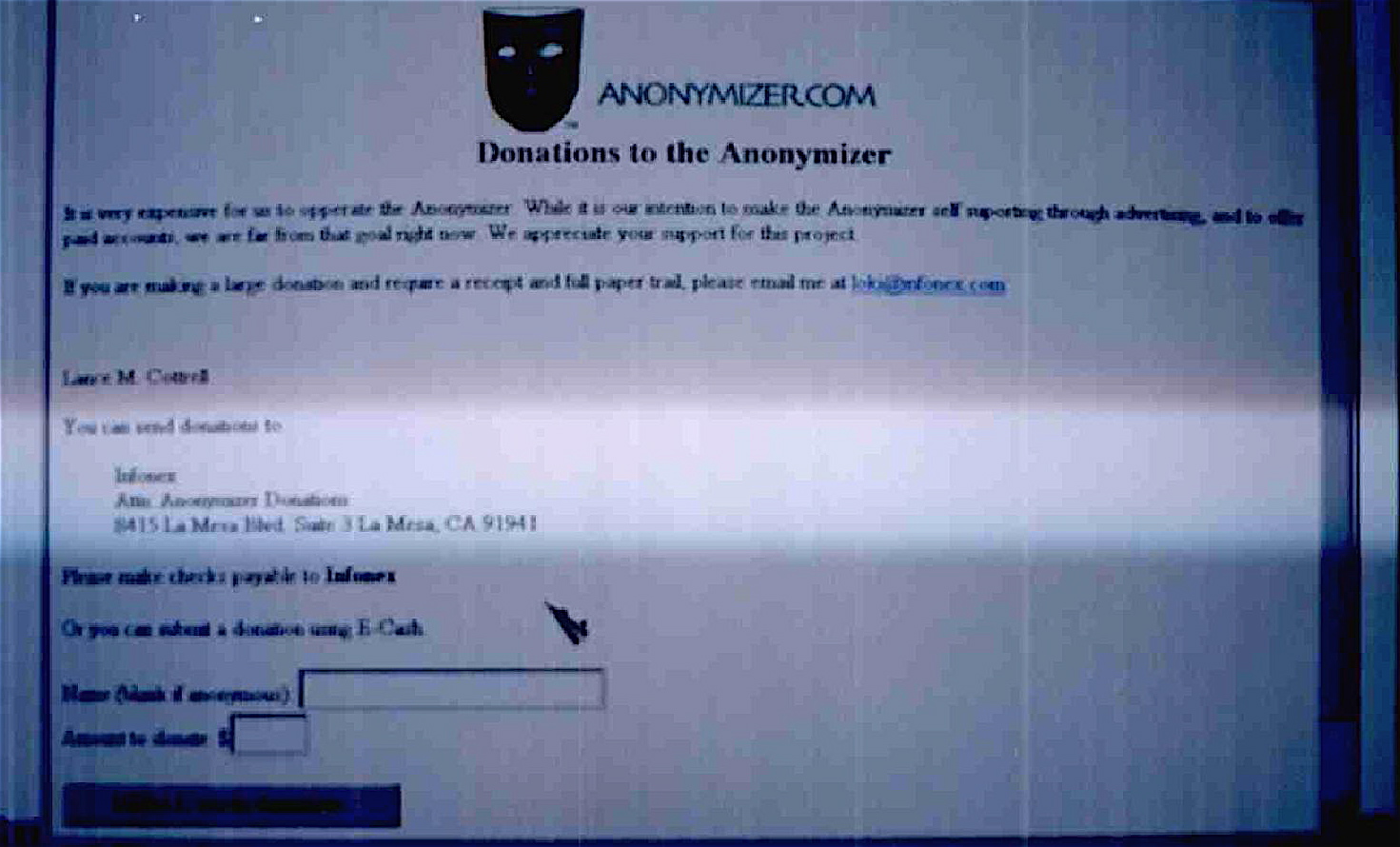
Lance’s early web pages for Anonymizer.com showed a mask, much like the Anonymous masks of today.  Have a look at a photo of a computer screen of an Anonymizer.com web page from way back then.    It's worth reading to get a taste for the history of the internet.  Compare this with today's  version of www.anonymizer.com which is all corporate slick.  

Anonymizer.com early screen asking for donations.
 To view a picture larger, you must pull/ drag it off the page and click it.
"Many people surf the web under the illusion that their actions are private and anonymous.  Unfortunately, it isn't so.  Every time you visit a site, you leave a calling card that reveals where you're coming from, what kind of computer you have, and other details."  "Our "anonymizer" service allows you to surf the web without revealing any personal information.  It is fast, it is easy, and it is free."

  Then here is Lance asking people to subscribe to a faster, for-pay Anonymizer for $10 per quarter, or $40 per year. "These paid accounts are never turned off or slowed down to save bandwidth!"  It even gives an option to pay online with MarkTwain Ecash.

Anonymizer Screen shot offering the service for $10 per quarter.
Here is Lance just outright begging for donations.  This makes me like him a bit.  Also, the fact that he misspelled "operate."

  
"It is very expensive for us to opperate the Anonymizer.  While it is our intention to make the Anonymizer self-supporting through advertising, and to offer paid accounts, we are far from that goal right now.  We appreciate your support for this project."  This was 1997.    

In 2005, Mr. Cottrell applied for a patent for the Anonymizer software with co-inventors Brian Bennett, Daniel Tentler, and Gene Anderson.   The patent application is extraordinarily well-written,  making the program understandable to those without extensive computer experience.  The application immediately makes clear how the software works and why someone would want to use it.  The patent was awarded in 2008 for "A system for protecting identity of network devices in a network environment. The system includes an apparatus having an interface to the network for completing connections to destination devices on the public side of the network. The apparatus includes a masking element for associating at least one masking identifier with a communication from the network device and masking the identifier of the network device from the destination device."

Lance Cottrell continued along as the "President, Founder, and Chief Scientist" of Anonymizer, until 2008.  Then, Lance Cottrell connected  with Richard Hollis Helms, the former CIA agent and CEO of Abraxas Corporation, and sold him Anonymizer, Inc.   Mr. Cottrell then became the Chief Scientist/ Chief Technology Officer of both companies.  It was also in 2008 that Anonymizer, Inc. first started taking out loans on its intellectual property. In 2010, Ntrepid Corporation was formed and Mr. Cottrell became its Chief Scientist.  Today he is employed by  Ntrepid Corporation, and Anonymizer, Inc. and is a consultant to Taia Global, Inc.

Lance Cottrell no longer needs to hound people to buy $10 subscriptions to Anonymizer.  Today, Anonymizer.com offers Anonymizer for Home and Anonymizer for Business.  The home user can get a one year subscription to Anonymizer for $80 or a souped-up version for $100/ year.  Anonymizer also offers Nyms, which are anonymous email accounts for $20/ year.

The Business products offered by Anonymizer, Inc. have a darker, more sinister tone.  These include such things as Non-Attributable IP (internet protocol) addresses and IPs that change addresses and locations automatically.  Anonymizer Inc also sells harvesters which gather information anonymously using fake IP addresses.  These products have so much potential for abuse in the hands of businesses and governments.

Anonymizer now also sells products geared to the spy crowd.  Do they make distinctions between government spies and private spies acting on behalf of governments, such as Stratfor?  Let's look at an ad for a service Anonymizer, Inc aims at governments, called Enterprise Chameleon.  (see ad below article.)  


As with Abraxas Corporation and TrapWire, Inc. the sales pitch for Enterprise Chameleon is one of fear of terrorists.  The ad explains how the government can use anonymity to spy on others.  This is a sad turn for a product associated with Lance Cottrell, who started his career designing software  to give online privacy to the individual user.  Now, in this Orwellian present, "privacy" means "spying on others."  


Lance Cottrell is widely known as a champion of online privacy.   He recently wrote on his blog that others have questioned his allegiance to privacy.  I assume they are questioning this since he is involved in the development of products that take away peoples' privacy and allows them to be spied on.   He wrote this blog post where he explains that he thinks he can comfortably supply services to players on all sides - the spies, the spied upon, and the spied upon who are spying right back:

"Some users of my personal / consumer privacy services see themselves as in opposition to some or all of my corporate or government users, and vice versa. I think both are important and I protect the anonymity of all of my customers equally. There is no “crossing of the streams.” None of my customers get any special insight into the identities or activities of any of my other customers. As above, there are no secrets like that which would last very long, and it would destroy my reputation.

Honor, reputation, and a man’s word being his bond may be very old fashioned ideas these days, but they carry great weight with me. I hope this clarifies where I stand." 


***