Where You Can Protest in Chicago and How
by Sue Basko
See also: Counter-Protesters and Counter-Demonstrators
Also see: Chicago NATO Summit Protests
Also see: Arrest and Bail in Chicago/ Eavesdropping
Also see: Illinois Eavesdropping Law and Video at Protests
Also see: Chicago News Media Credentials
See also: High School Protest Rights
Also see: Chicago NATO Summit Protests
Also see: Arrest and Bail in Chicago/ Eavesdropping
Also see: Illinois Eavesdropping Law and Video at Protests
Also see: Chicago News Media Credentials
See also: High School Protest Rights
Here is a basic beginner summary of Where You Can protest in Chicago:
PROTESTING is legal! That is the most important thing you need to know.
Summed up, in Chicago, you can plan a protest WITH NO PERMIT NEEDED if you plan it for a publicly-owned sidewalk in the main area of the City or a publicly-owned plaza. If you are planning your first protest, you want to do it as legally as possible and as cheaply as possible. There will be glitches that might happen anyway, but you want it to go as smoothly as possible from your side.
Basic Rule: No Permit needed for protest at Public Plaza or Public Sidewalk in main area of city.
The MAIN publicly owned plazas in Chicago are Richard J. Daley Center Plaza (by the Daley building on Dearborn - Clark - Washington - Randolph), the State of Illinois James R. Thompson Center plaza (on Clark - LaSalle - Randolph - Lake) and the Federal Plaza (by the Post Office on Adams - Jackson - Dearborn - Clark). It is logical to pick the plaza that represents what you are protesting -- if it is a city issue (Daley), state issue (Thompson), or federal issue (Federal plaza). You don't have to protest at the most apt location, but it makes sense to direct your protest at the people or institutions from which you seek redress of your grievances. That is Constitutional language.
In Chicago, the three main public plazas are also notable for their big sculptures. If you are planning a protest in any of these locations, you can send out a picture of the sculpture and tell people to meet up by the sculpture. These make great landmarks for people who do not know their way around the City.
Daley Center Picasso:
Daley Center plaza has plenty of space, but often has such things as holiday festivals.
 |
| Photo by Susan Basko. Picasso sculpture in Daley Center plaza. |
State of Illinois James R. Thompson Center's Jean Dubuffet:
The State of Illinois Thompson Center plaza has very limited space. The upside is that during weekday business hours, there are a food court and public bathrooms in the basement of the building.
 |
| Photo by Premundo. Public Domain use. Thompson Center with Dubuffet Scupture out front. |
This plaza has plenty of space and there will often be other protest groups at same time. Sometimes there will be a farmer's market or craft fair going, but there should still be space for a protest.
 |
| Photo by Jeremy A., Fair Use. ChicagoFederal Plaza Alexander Calder "Flamingo" sculpture. |
Some protests will target the sidewalk in front of the exact building where the topic of their protest occurs, such as a county building, immigration office, etc. You need to do your research and go on a reconnaissance mission to be sure you are choosing the correct location.
You can also march on the public sidewalks to your heart's content, but let others pass on the sidewalk. Tell your protesters to be polite to others and to offer information if asked. A lot of people want to know what is being protested, what your main talking points are. It's nice if your protesters can sum it up in a single sentence, with more detail for those in the public who want to know more. That's how your protest can educate the public and possibly win them over.
Some experienced protest organizers run protests in public and private buildings, in the parks, or close traffic by marching in streets. Usually these are people who are willing to get arrested. Fairness dictates that if you want people to attend, you should run your protest legally so that your protesters' lives are not disrupted by arrest. Let the first protest you plan be safe, legal, and a good experience for all involved.
and on to the show:
****
“There is no where to practice free speech in Chicago,” tweeted someone at the Occupy Chicago protests, which have been repeatedly kicked out by the police. This is a guide to WHERE YOU CAN PROTEST IN CHICAGO AND HOW, with quotes from the pertinent sections of the law.Chicago has certainly greatly curtailed Free Speech and Assembly with the following:
in the Chicago Parks – Gatherings of over 50 people or that use a sound system require a permit, a permit fee, and various expenses. This should not be. There should be designated Free Speech areas, such as Washington Square Park by Newberry Library, which was Chicago's premiere free speech park; and the park space at Michigan Avenue and Congress, known as Congress Plaza ( also known as "the horse" for the historic horse statue there), from which protesters were recently arrested for violating park closing time. No such designated Free Speech and Assembly space exists, and that is a shame, since these rights are being given the chill in most Chicago locations. MAP OF GRANT PARK, CHICAGO
 |
| Picasso Sculpture in Daley Plaza, Chicago |
Plazas – Daley Plaza. Chicago over-books Daley Plaza with all sorts of events, that while charming, use up the one main space that Chicagoans should have available for free speech and assembly. The plaza is even rented to commercial markets. “Rallies” can book the space far in advance, and if they don’t build any stages or other structures and don’t use any set-up workers or electricity from the building, can use the space for free. Still, it seems one space on the plaza should be reserved for First Amendment activity any day, and one day each week should be reserved only for First Amendment activity. Perhaps Free Speech Wednesdays? In addition, every evening should be available for free speech rallies. By law, a public plaza can be used any time 24/7, with no permit, for free speech and assembly. But if the space is filled with a holiday village or a crafts fair, how can this happen?
State of Illinois Thompson Building Plaza. This building should have a robust First Amendment system in place, and instead has a commercial building management booking spaces for high prices to commercial enterprises. A recent peaceful nighttime vigil in honor of Scott Olsen, a marine critically wounded by a police officer in Oakland, was met at the Thompson Plaza by an intimidating line of police in tactical gear. That chills free speech, to say the least. Such actions by the State make people feel they are somehow wrong or criminal to peaceably assemble for free speech purposes. Heavy police presence at a peaceful vigil service was ugly and un-American.
WHERE CAN WE PROTEST IN CHICAGO and HOW?
In Chicago law, there are two types of protests: Rallies (public assemblies), and marches. Rallies stay in one place and marches move. Many or most marches begin and/or end with a rally. A rally has to take place in a public plaza, or in a park space if you have a permit for the park space. The march can take place on the sidewalk, or on the street if you have a permit for a street march.
THE EASIEST TYPE OF PROTEST in Chicago that does not need a permit or insurance is a simple rally in a public plaza followed or started by a sidewalk march. To avoid the permit, your group must stay out of the street and not erect any structures and not block the flow of vehicle or pedestrian traffic. If there is another group that has reserved the plaza, your group cannot interfere with them.
Chicago law treats different types of public places differently for public assembly purposes. I have grouped the types of locations and listed the regulations that apply to each. I also added pertinent sections of the Noise Ordinances, as well as Chicago's Disorderly Conduct law.
PRIVATELY-OWNED PLACES: Keep in mind -- PRIVATELY-OWNED places are never available for protest activity. That includes shopping malls, private college campuses, businesses or offices, anyone's home, etc. First Amendment exists between the government and the people only. Illinois Criminal Code 720ILCS 5/ Art.21.1) specifically prohibits "picketing" outside anyone's residence, other than outside your own. Flash Mobs: Some people DO plan flash mob protests on private property, and you can read about those HERE.
MEDICAL FACILITIES/ CHURCHES: Protesting is not allowed near hospitals, clinics, or any other type of medical facility, or near or in places of worship. If you plan such a protest, consult first with a lawyer. Chicago law prohibits making any noise or otherwise disrupting any religious service.
IN Chicago, the types of public spaces where you are likely to hold a protest are: (see the detailed explanations further below)
I) inside of public buildings, such as City Hall;
II) sidewalk, not interfering with vehicular or pedestrian traffic flow;
III) sidewalk, not interfering with vehicular traffic, but reasonably expected to interfere with pedestrian traffic;
IV) street, requiring street closure or rerouting of traffic;
V) public plazas, that is, publicly-owned plazas open to the public.
VI) park property. Park property is divided into parks, beaches and golf courses. This post deals only with parks, not beaches or golf courses.
VII) NOISE LAWS, SOUND SYSTEMS, MEGAPHONES, AND DRUMMERS
VIII) CHICAGO DISORDERLY CONDUCT LAW
* * * * * * * ** * * * * * * * * * * * * * * * * *
I) INSIDE PUBLIC BUILDINGS: MEETINGS: If you wanted to hold a protest inside a building owned by the City, you would need a permit, but one would never be given. But you can protest on the public sidewalk outside, just not too near the doorways. If you want to attend and watch or speak at City Council, a Council Committee, the School Board, Park District board, or other such meeting, you can check online for the schedules, locations, and rules for being allowed to speak. For the most part, you can come to such a meeting with the people in your group, but you probably won’t be allowed to make noise, probably won’t be allowed to carry signs, and will have to follow the agenda and time limits on speaking. If you want your topic to be on the agenda, you need to read up on how to make that happen.
Some people go in groups to the office of the Mayor or Governor trying to spontaneously get a meeting or to drop off a petition or document. These officials are usually not in their offices, though sometimes a friendly staff person will talk with a group. If you really want to set up a meeting, call ahead and ask to schedule a meeting. Dress and act professionally if you want to be taken seriously.
Protest groups often DO protest in public buildings, but they usually do so with the intent and plan that they are going to get arrested. Sometimes they will sit in a hall or block elevators. In Chicago, the police or security will usually warn the group, and will often ask each person if they want to leave or be arrested.
II) SIDEWALKS, NOT INTERFERING WITH VEHICLE OR PEDESTRIAN TRAFFIC:
This is the most common form of protest in Chicago where you do not need a permit. You have the right to march in protest on the public sidewalk. If you take up only half of the sidewalk and do not impede the normal flow of pedestrian traffic and if all of your group stops faithfully at each crosswalk and follows the “walk” signal, then you may do so without informing anyone or getting a permit. However, you must be careful with the rules about noise and any amplifying system, and with any musicians, such as drummers. This will be covered further below.
Illinois Criminal Code 720ILCS 5/ Art.21.1) specifically prohibits "picketing" outside anyone's residence, other than outside your own.
If you are holding a sidewalk march, you should tell the participants to be polite to others on the sidewalk, not to bump into people, not to curse, etc.
DRUMMERS: Drummers are okay as long as it is not night and as long as the march is not near an outdoor concert, or near a church or religious building that is holding services, and not near a hospital with sick patients staying inside. If your march keeps moving along, your drum noise also moves along, and no one will be too bothered by it. However, if you situate your protest in one location and have nonstop drumming, there are bound to be complaints.
March must move. Chicago Police sometimes show up at sidewalk protests that intend to stay in one location and enforce a "keep moving" policy where they make the protesters keep walking in a big loop. Maybe this technicality makes it a protest march? If you want to stay in one place, that is a rally, and you need to do that in a publicly-owned plaza. Read on that below.
If you are going to impede normal flow of pedestrian traffic, Chicago law says to inform the Commissioner of the Department of Transportation of your intent, as explained just below.
Crossing the river: If your march is in downtown Chicago and you start south of the river, and you try to cross to north of the river, the police will not likely allow this. This may or may not be a legal limitation, but it is likely to happen. The City now considers North Michigan Avenue more or less off-limits for protests, because there have been problems with flash mob robberies and large annoying groups. If you want to avoid trouble, don't plan your protest north of the river on Michigan Avenue. If you do plan it there for some reason, you will most likely run into trouble or arrests.
III) SIDEWALK, REASONABLY EXPECTED TO INTERFERE WITH VEHICLE OR PEDESTRIAN TRAFFIC: For this, you must contact the Commissioner of the Department of Transportation, as the laws below explain.
Commissioner of the Department of Transportation Permit Office:
The permit office is open weekdays (excluding holidays) between 8:30 AM and 4:30 PM and is located at:
City Hall – Room 905
121 North La Salle Street
Tel: 312-744-4652 Fax: 312-744-4627
PUBLIC ASSEMBLY: In Chicago law, “public assembly" is defined as “(I) a company of persons which is reasonably anticipated to obstruct the normal flow of traffic upon the public way and that is collected together in one place, or (ii) any organized march or procession of persons upon any public sidewalk that is reasonably anticipated to obstruct the normal flow of pedestrian traffic on the public way, but which does not meet the definition of parade set forth in this subsection.”
“Public assembly” requires you to contact the Commissioner of the Department of Transportation five days in advance, or as soon as practicable if must hold your public assembly asap because it is spontaneous or of an urgent nature.
How to Get the Permit for a Public Assembly:
10-8-330 Parade, public assembly or athletic event.( r ) Any person or organization planning to lead or initiate any type of public assembly, including a march or procession upon a public sidewalk, as defined in subsection (a), shall notify the commissioner, at least five business days in advance, or as soon as practicable if the event is of a spontaneous or urgent nature, and shall inform him or her of the date, time, location, route and estimated number of persons participating, so that the city can make any preparations necessary to provide personnel or other city services to minimize the obstruction to pedestrian and other traffic and to otherwise protect the participants and the public. Such public assemblies shall be allowed unless the commissioner informs the person or organization giving the notice, within two days or as soon as practicable before the scheduled event, that there would be a direct interference with a previously planned permitted activity or public assembly, or that there is a significant public safety issue, limited to those set forth for parades in subsection (h)(1) – (3). If the commissioner does this, he or she must state the reasons in writing and give an alternative date, time, location or route, as provided for parades in subsections (j) and (l) herein. If the public assembly organizer desires to appeal such decision, then the appeal shall be governed by the procedures set forth for parade permits in subsection (m) herein, if the notification was received in sufficient time that the appeals process could be completed before the planned date; if not, the decision by the commissioner shall be deemed a final decision subject to judicial review in accordance with applicable law. Upon request, the commissioner will provide the organizer of the public assembly with a stamped copy of the notice given under this subsection.
How Does the Commissioner Decide?
(h) After such investigation, the commissioner shall issue a permit when he or she finds that:
(1) the proposed activity will not substantially or unnecessarily interfere with traffic in the area contiguous to the activity, or that, if the activity will substantially interfere with such traffic, that there are available at the time of the proposed activity sufficient city resources to mitigate the disruption;
(2) there are available at the time of the parade or athletic event a sufficient number of peace officers and traffic control aides to police and protect lawful participants in the activity and non-participants from traffic related hazards in light of the other demands for police protection at the time of the proposed event or activity;
(3) the concentration of persons, animals, vehicles or things at the assembly and disbanding areas and along the parade or athletic event route will not prevent proper fire and police protection or ambulance service;
FIVE DAYS IN ADVANCE MAY REALLY BE 7 DAYS:
(4) “Business days” means those days in which municipal offices are open for conducting city business and does not include Saturday, Sunday or such holidays as are listed in Section 2-152-090.
IV) STREETS: PROTEST MARCH OR RALLY WHERE STREET CLOSING IS NEEDED: A permit is required. In Chicago law, a “parade” “means any march, procession or other similar activity consisting of persons, animals, vehicles or things, or combination thereof, upon any public street, sidewalk, alley or other public place, which requires a street closing or otherwise requires police officers to stop or reroute vehicular traffic because the marchers will not comply with normal and usual traffic regulations or controls. “Large parade” means any parade that is held in the “central business district”, as defined in Section 9-4-010, and any parade that is anticipated to require city services exceeding $20,000.00 in value, to be adjusted for inflation in a manner specified by regulation.”
The process of getting a permit to close a street in Chicago is quite complex, and First Amendment protest activities compete with all kinds of ethnic parades, holiday parades, sporting events, as well as with all the other protest groups. Many of the bigger parades are long-standing annual events, and those groups vie for their time slots by showing up as soon as the permit office opens after the New Year. If you want to close a street in Chicago so you can hold a protest, you are best to consult with a lawyer and have help in learning the application process and putting your best foot forward.
V) PUBLIC PLAZAS IN CHICAGO: People should be able to protest freely in public plazas. In Chicago, plazas in parks are controlled under parks law, which is below, and parks close at 11 pm. The non-park plazas should be available for free speech activity 24 hours a day with no reservations required, but that is not the case in Chicago. This is a big problem and is probably unconstitutional. No matter what is going on with the plazas in Chicago these days, you should still be able to protest on the public sidewalk surrounding the plazas. Also, if any area of free speech needs to be clarified asap, it is use of these public plazas. NOTE: The plaza along Michigan Avenue nicknamed "The Horse" is a park plaza, and therefore, has a closing time.
CHICAGO PUBLIC PLAZAS: Chicago’s main downtown public plazas are:
 |
| Daley Plaza, as seen from the west. |
Daley Plaza, which is owned by the City. It is located on Washington Street between Dearborn and Clark (118 North Clark). This is the place with the Picasso sculpture. This area should be reserved for Free Speech activities by the people of Chicago, and instead is booked with “cultural programming,” every day at noon, Farmer’s Markets, events for Halloween, Oktoberfest, Christmas and on and on. A protest group should be able to at least fit itself into some corner of the plaza, or at very least, use half the public sidewalk around the perimeter.
Where are the people of Chicago supposed to go to peaceably assemble for redress of government? The City of Chicago has completely “programmed” its plazas and parks to prevent any meaningful First Amendment activity. This is most likely against the U.S. Constitution and I would like to see someone go to court on this. Better yet -- I'd like to see the City administration change this serious problem on its own accord.
The Daley Plaza now requires an application to hold a ‘rally” at the plaza. The application must go in 30-365 days in advance. Obviously, the further in advance you get it in, the more likely you are to get your desired date and time. You will need to buy insurance for any “erection or construction of displays, structures or exhibits.” If your rally will not do such things, you do not need insurance. If you do not need assistance from the building staff for any equipment or electrical set-up, and if you do not require insurance, then there is no fee. If you require any of those things, there is a fee of $250 for two hours, and an additional $100 for each extra hour, for a total up to $750. This is the application: http://www.thedaleycenter.com/uploads/ApplicationforPermit2.15.11.pdf
State of Illinois Building, James R. Thompson Center Plaza, 100 West Randolph Street. http://www2.illinois.gov/cms/About/JRTC/Pages/default.aspx This is the State of Illinois building with a Jean Dubuffet sculpture out front. This is the Clark and Lake CTA train stop, where many train lines from all parts of the city stop. This makes it an ideal centralized location for a protest. Any protest should be able to show up at the plaza and protest in a peaceful way as long as they keep away from the windows. The Lake Street side of the building is best to avoid, because it is too narrow a space between the street and the glass windows and doors, and is where the entry to the CTA station is located. The larger area on the Randolph Street side is best for any protest rally or ceremony. To contact the building office in advance:
Wilma Wilbon
Special Events Director
James R. Thompson Center
Chicago, IL 60601-3220
Phone: 312-814-6676
TDD: 312-793-3500
E-mail: Wilma.Wilbon@illinois.gov
Kluczynski Federal Building Plaza, 50 West Adams. http://www.gsa.gov/portal/content/101886 This plaza is part of the federal government and has a red steel sculpture by Alexander Calder. The plaza has a Farmer’s Market. The space is large and should be a prime location for vibrant, peaceful Free Speech Assembly. Marysia Davis is the property manager, 312-353-4475.
VI) CHICAGO PARKS:
 |
| Cloud Gate, aka The Bean, Millennium Park, Chicago |
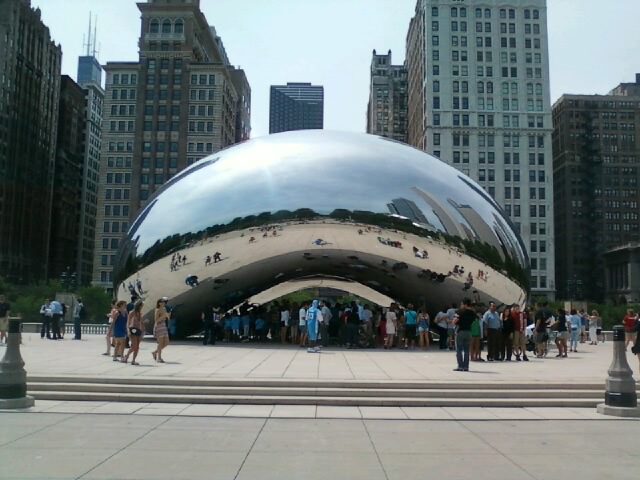
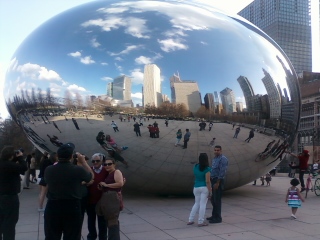
MILLENNIUM PARK: Millennium Park is its own little fiefdom. From the Parks law: “Millennium Park: (d) The commissioner is authorized to enter into use agreements for the temporary use of space and facilities in the Park. The commissioner shall only enter into use agreements that the commissioner determines enhance and are consistent with the unique nature of the Park, but in no event shall the commissioner discriminate on the basis of race, national origin, religion, partisan political affiliation, or viewpoint of the applicant seeking a use agreement, or on any other basis prohibited by the Constitution of the United States or the State of Illinois.”
Translation: Millennium Park is too fancy pants for protest riff-raff. However, protesters should be able to march on one-half the width of the public sidewalk around the perimeter of the park, as long as you are not violating the sound ordinance (not using amplifiers or megaphones in violation of law) and do not have drummers, since no street performers are allowed on the sidewalk abutting Millennium Park. You might argue that these are not street performers, but if you are making loud noise on the perimeter of Millennium Park, you are most likely to be forced to leave.
ALL OTHER PARKS:
CLOSING TIME: All Chicago parks are closed from 11 pm to 4 am. That means you have to leave by 11 pm or you are subject to arrest. In most instances, the police will give you the option to leave before you are arrested.
Map of GRANT PARK
link to PARK DISTRICT PERMITS OFFICE
PERMITS NEEDED FOR PROTEST IN A PARK: If you plan an event with 50 or more people, you need a park permit. A permit is also needed for any use of tents, to reserve a specific location, or to use sound amplification equipment. Any tent with a surface area over 240 square feet surface area must have a building permit. Tents may only be up and in use for 60 consecutive days. Where a tent is in use, there should be portable toilets also in place. There are other requirements regarding electricity and cooking near any tent.
PERMITS NOT NEEDED FOR PROTEST IN PARK IF: IF your protest is under 50 people, IF you are not using tents or sound equipment, and IF you are flexible about location in case someone else has reserved your desired spot, you should not need a park permit. HOWEVER, there is a strict closing time of 11 pm and you are subject to arrest if you do not leave by 11 pm. Keep in mind, you can always be on half the width of the public sidewalk (not the sidewalk within the park). Also, keep in mind, this does not apply to Millennium Park, which reserves its own spaces. Also, any sound you make in a park cannot interfere with any other event that got a permit to use space nearby.
INFORMATION FROM PARK DISTRICT SITE:
If you are planning an event in the parks, you may need to secure a Special Event Permit in order to proceed with your event. Certain activities that require a Special Event Permit may include, but is not limited to, the following:
- events with 50 or more participants
- use of amplified sound
- any advertising or sponsorship activities, and merchandise, etc.
- selling/distributing any food, goods or merchandise (including exercise classes/bootcamps)
- liquor
- tents
- inflatables
- stages
- reservation of a specific location
Please keep in mind that there are other activities or proposed event features that may require you to secure a permit. If you are unsure whether your special event will need a permit, please contact the Department of Park Services at: (312) 742-5369.
CHICAGO PARK DISTRICT: Permit Application Process:
Choose a specific park location and date for your event. (Please consult the downloadable maps on the right for lakefront locations.). You are encouraged to choose an alternative location and/or date in the event that your first choice is not available. Events of 50 or more people and those events with special features are required to secure a Special Event Permit.
If you are unsure whether or not a permit is required for your event, please refer to the Park District Code or call the Department of Park Services at (312)742-5369.
Please be sure to complete all sections of the Special Event Permit Application. All proposed activities and events are subject to the approval of the Park District. The Park District will not consider your submittal if the application is incomplete and does not include the $35 application fee.
Submit the completed application (pages 12 through 21) and $35 application fee by email, mail, delivery in person, or fax to the Department of Park Services or appropriate Region Office. Submittal of an application does not grant you a permit or confirmation to conduct your planned event; all applications are subject to review. Completed applications with appropriate fees and requested documentation/information must be submitted at least 45 or 30 days prior to your event depending on your permit level; otherwise, late fees may apply (refer to Fees and Fee Deadlines on page 8).
PLEASE NOTE: Only applications delivered in person will be processed on January 3, 2011 beginning at 8:00 a.m. until 3:00 p.m. Applications submitted by mail, e-mail and fax, and all applications received prior to 8:00 a.m. on January 3, 2011, will not be processed until January 4, 2011. The Park District cannot guarantee that all applications received prior to January 3, 2011 at 8:00 a.m. will be processed in the order received on January 4, 2011. Furthermore, only completed applications submitted with the $35 application fee will be processed.
The Park District processes applications for permits in order of receipt. The Park District will not consider your submittal without a completed application and a $35 application fee.
Upon receiving your completed application and $35 application fee, the Park District will contact you within 14 days to inform you of the status of your application. You will be informed of any remaining fees that must be paid (please see Fees and Fee Deadlines, page 8), along with any additional documentation requirements. The Park District reserves the right to require additional information or documentation regarding the applicant, applicant’s company, sponsoring company/organization, cosponsors, event participants, event vendors, event activities, or the event itself. Moreover, the Park District may postpone approval of event permits until receipt of additional requested information or documentation. Failure to submit requested information or documentation in a timely manner may be cause for denial of a park permit.
Applicants must submit two documents to satisfy insurance requirements. A (1) Certificate of General liability insurance in the amount of $1,000,000 naming the Chicago Park District as “additional insured” and the certificate holder for the date(s) of your event including set up and tear down dates. Applicants must also submit an (2) Endorsement issued by the insurance carrier. The Endorsement issued under their General Liability policy of insurance, including coverage for property damage while property is occupied by the permittee, for the event that reflects that the Chicago Park District is an additional insured for the event.
Your permit will not be issued if both the Certificate of Insurance and the Endorsement have not been received and approved 48 hours prior to an event.
Applicants are required to inform the Chicago Park District in writing of any and all amendments to the original application prior to the event day.
Once all the Park District’s requirements have been fulfilled, including receipt of all documents and full payment, a Special Event Permit will be issued.
PLEASE NOTE: Costs incurred promoting and marketing events prior to the issuance of an approved Special Event Permit from the Chicago Park District and changes/modifications relative to the event from the Chicago Park District and/or the Mayor’s Office of Special Events and other City of Chicago departments is at the sole expense and risk of the Event Organizer.
Submit the completed Special Event Permit Application to:
Chicago Park District
Department of Park Services
541 N. Fairbanks Court, 4th Floor
Chicago, IL 60611
Or via Fax: (312) 742-6038
QUESTIONS: : (312) 742 - 5369
CHICAGO PARKS DO NOT ALLOW: Glass containers; alcohol; intoxication; dogs, except on leash under 6 feet; open flame or cooking except where specifically allowed.
VII) NOISE LAWS, SOUND SYSTEMS, MEGAPHONES, AND DRUMMERS:
Chicago has many noise ordinances, many of which overlap. The two below seem most apt to protests. Chicago also requires all street performers to be licensed. Do drummers performing with a protest have to be licensed? The City might argue yes. I would argue it is part of the First Amendment protest, not street performance. However, there cannot be any drumming or other loud noise after 8 pm anywhere, unless there is a permit for it, as the law below states. Also, no street performance is allowed on the sidewalk abutting Millennium Park, and in some other locations. There is also no music street performing allowed on the sidewalks across from Millennium Park when a concert is about to start or during a concert at the Pritzker Pavillion. In other words, you cannot play music out on the street that may interfere with the outdoor concerts held in the park. Also, Chicago has “Quiet Zones” near hospitals, schools, and churches. Don’t drum after 8 pm or in any quiet zone. If you are told to stop drumming, you are most likely in violation of the complex and overlapping Chicago noise ordinances. See the laws below to properly plan noise for your protests.
NOISE BY DAY:
Part B. Limitations on Noise from Specific Sources.
11-4-2800 Music and amplified sound.
(a) No person on the public way shall employ any device or instrument that creates or amplifies sound, including but not limited to any loudspeaker, bullhorn, amplifier, public address system, musical instrument, radio or device that plays recorded music, to generate any sound, for the purpose of communication or entertainment, that is louder than average conversational level at a distance of 100 feet or more, measured vertically or horizontally, from the source.
(b) Between the hours of 10:00 p.m. and 8:00 a.m., no person on any private open space shall employ any device or instrument that creates or amplifies sound, including but not limited to any loudspeaker, bullhorn, amplifier, public address system, musical instrument, radio or device that plays recorded music, to generate any sound, for the purpose of communication or entertainment, that is louder than average conversational level at a distance of 100 feet or more from the property line of the property from which the noise is being generated.
(c) The limitations imposed in this section do not apply to a person participating in a parade, athletic event, public assembly, or outdoor special event, as defined in section 10-8-330 or 10-8-335 of this Code; provided that a permit has been issued, if required, and the person is in compliance with the permit.
NOISE AT NIGHT:
Part C. Other Limitations on Noise and Vibrations.
11-4-2900 Limitations on noise not otherwise addressed.
For any noise source not specifically addressed in Part B of this article, except where exempted or excluded by section 11-4-2920, the following general limitations shall apply:
(a) Between 8:00 P.M. and 8:00 A.M., no person shall generate any noise on the public way that is louder than average conversational level at a distance of 100 feet or more, vertically or horizontally, from the source.
(b) Between 8:00 P.M. and 8:00 A.M., no person shall generate any noise on any private open space that is louder than average conversational level at a distance of 100 feet or more, measured from the property line of the property from which the noise is being generated.
(Added Coun. J. 7-26-06, p. 81473, § 1)
VIII) CHICAGO DISORDERLY CONDUCT LAW:
8-4-010 Disorderly conduct.
A person commits disorderly conduct when he knowingly:
(a) Does any act in such unreasonable manner as to provoke, make or aid in making a breach of peace; or
(b) Does or makes any unreasonable or offensive act, utterance, gesture or display which, under the circumstances, creates a clear and present danger of a breach of peace or imminent threat of violence; or
(c) Refuses or fails to cease and desist any peaceful conduct or activity likely to produce a breach of peace where there is an imminent threat of violence, and where the police have made all reasonable efforts to protect the otherwise peaceful conduct and activity, and have requested that said conduct and activity be stopped and explained the request if there be time; or
(d) Fails to obey a lawful order of dispersal by a person known by him to be a peace officer under circumstances where three or more persons are committing acts of disorderly conduct in the immediate vicinity, which acts are likely to cause substantial harm or serious inconvenience, annoyance or alarm; or
(e) Assembles with three or more persons for the purpose of using force or violence to disturb the public peace; or
(f) Remains in the public way in a manner that blocks customer access to a commercial establishment, after being asked to clear the entrance by the person in charge of such establishment.
(g) Appears in any public place manifestly under the influence of alcohol, narcotics or other drug, not therapeutically administered, to the degree that he may endanger himself or other persons or property, or annoy persons in his vicinity; or
(h) Carries in a threatening or menacing manner, without authority of law, any pistol, revolver, dagger, razor, dangerous knife, stiletto, knuckles, slingshot, an object containing noxious or deleterious liquid, gas or substance or other dangerous weapon, or conceals said weapon on or about the person or vehicle; or
(i) Pickets or demonstrates on a public way within 150 feet of any primary or secondary school building while the school is in session and one-half hour before the school is in session and one-half hour after the school session has been concluded, provided that this subsection does not prohibit the peaceful picketing of any school involved in a labor dispute; or
(j) Pickets or demonstrates on a public way within 150 feet of any church, temple, synagogue or other place of worship while services are being conducted and one-half hour before services are to be conducted and one-half hour after services have been concluded, provided that this subsection does not prohibit the peaceful picketing of any church, temple, synagogue or other place of worship involved in a labor dispute.
(k) Either: (1) knowingly approaches another person within eight feet of such person, unless such other person consents, for the purpose of passing a leaflet or handbill to, displaying a sign to, or engaging in oral protest, education, or counseling with such other person in the public way within a radius of 50 feet from any entrance door to a hospital, medical clinic or healthcare facility, or (2) by force or threat of force or by physical obstruction, intentionally injures, intimidates or interferes with or attempts to injure, intimidate or interfere with any person entering or leaving any hospital, medical clinic or healthcare facility.
A person convicted of disorderly conduct shall be fined not more than $500.00 for each offense.
(Prior code § 193-1; Amend Coun. J. 3-27-02, p. 82299, § 1; Amend Coun. J. 12-4-02, p. 99931, § 5.1; Amend Coun. J. 4-9-03, p. 106396, § 1; Amend Coun. J. 7-26-06, p. 81863, § 1; Amend Coun. J. 10-17-09, p. 72710, § 1)
See also: